
CANBAN // DOCS
Canban Documentation & Guides
Canban (canban.dev) is local-first with zero data collection and no relay servers. It unifies Kanban cards for Human Context, declarative schema 13 Workflows with cardless GitHub events and encrypted secrets, Timeline-first Insights, an Agent-first CLI, and Herdr persistent PTY terminals across local and direct end-to-end encrypted remote hosts.
Run Claude Code, Codex, Antigravity (agy), Pi, and Cursor CLI simultaneously with Kanban context, Git worktrees, Attention Inbox (⌘I), FIFO Queue Merge, and Insights.
Guide: Native Terminal & Multi-Machine →Why Rust + libghostty-vt + Herdr PTYs beat terminal tabs, tmux, and chat wrappers — plus 24/7 remote Linux execution over yamux/1 Tailscale TCP, SSH, and offline sync.
Guide: Scheduled Worktree Cleanup →Pure-script global schedule (zero agents, zero PTYs) that safely reclaims merged, clean, 7-day-idle Git worktrees and writes per-repo GB & failure summaries to a Card.
Workflow YAML & Semantics →Verified schema 13 Document/Step syntax, card agent assignees & default_agent/override, cardless GitHub event rules, encrypted secrets & vars, all 9 uses: types, condition pointers, admit gates, rework/failure handling, and FIFO Queue Merge.
Canban CLI & --human →Core CLI subcommands, compact JSON & server-side --fields shaping, zero-config env injection, request_key idempotency, and --human usage.
Native Agent CLIs & Herdr PTYs →All 24 built-in CLI agents, agy dual-role Orchestrator config, managed terminal presence leases & auto-reclaim, libghostty-vt preservation, and canban card adopt.
Remote Linux Hosts (canband) →Headless Linux canband daemons, mandatory Noise_XX E2EE with X25519 public-key auth & host key pinning (no relay servers), optional Tailscale WhoIs auto-auth & Tailnet discovery, SSH fallback, offline 3-way sync, and Diagnostics.
Install & FAQ →Desktop macOS/Linux and headless server installation, Linux GTK4/GStreamer dependencies, and answers to common questions.
Changelog →Published Canban releases, latest versions first, with original release notes.
System architecture
Canban is built in Rust with native UI (longbridge/nsh — AppKit/Metal on macOS 13.0+ Apple Silicon, GTK4 on Linux x86_64 / arm64) and libghostty-vt for terminal emulation.
- Canban UI (
canban-ui): Connects over Unix socket (~/.canban/app.sock) to localAppServer, and simultaneously to remotecanbandhosts directly over mandatoryNoise_XXend-to-end encryptedyamux/1TCP (pure X25519 public-key auth, optional Tailscale WhoIs auto-auth, or managed SSH tunnels) with async push streams (app.subscribe), alongside shared native iOS/Android mobile UI support. - AppServer (
canban serve/canband): Owns SQLite WAL storage, encrypted per-host Vault secrets, Cards, the Workflow Engine, Scheduler, Git worktree management, and Merge Queue coordination. Closing the desktop window leaves background scheduling active. - Herdr Core (
hc): Persistent PTY session supervisor running native Agent CLIs (claude,codex,agy,pi,gemini,opencode,cursor-agent, etc.) so running agent sessions survive UI restarts and upgrades.
Privacy & security (zero data collection, direct E2EE)
Canban is designed to be local-first, zero-telemetry, and directly end-to-end encrypted with no cloud account and no relay servers:
- Zero data collection: Canban embeds no analytics, telemetry, crash reporting, or tracking. Boards, cards, comments, timelines, workflows, and secrets stay strictly on your own machines in local SQLite (
canban.sqlite). - Encrypted secrets at rest (
XChaCha20-Poly1305): Each host generates an independent 256-bit<CANBAN_HOME>/vault.key(0600) and encrypts secret values in SQLitevault_entrieswith AAD binding. Snapshots and previews never expose plaintext secrets. - Mandatory direct E2EE over TCP (
Noise_XX) — zero relay servers: Desktop, mobile, and remotecanbandhosts connect directly to each other with zero third-party relays. Every TCP connection begins with theCBN1wire preface and performs a mutualNoise_XX_25519_ChaChaPoly_BLAKE2shandshake (pure Rustsnow, zero silent plaintext downgrade — legacy plaintext clients receive-32002and disconnect immediately), wrapping JSON-RPC, push streams, live PTY terminals, and secret replication inside one AEAD-encryptedyamux/1channel. - X25519 public-key auth & host key pinning: Servers persist a static X25519 identity in
<home>/noise.key(0600) and authorize client public keys in<home>/authorized_devices.jsonvia 5-minute single-usepair_...pairing codes,canban device authorize, or optional TailscaleWhoIs. Non-Tailscale pairing URIs require?pk=<base64url>and verify the server's static public key before Noise Message 3 (halting immediately on mismatch without leaking client identity or consuming the pairing code); Tailscale connections support first-connect TOFU and pin the learned key locally. - Optional Tailscale or SSH: Direct E2EE works out of the box over any LAN or private VPN. You can optionally pair with Tailscale (private mesh networking plus zero-QR same-account
WhoIsauto-auth) or SSH (managedssh -LUnix-socket forwarding). - Untrusted external PR isolation & network boundary: Unattended workflow runs for
external_pror untrusted external events forceMinimal (PATH only)env, skip all secrets, and mask secret values in logs. Outbound network connections go only directly to GitHub (when you enable GitHub integration or release update checks) or to the model providers configured in your own Agent CLIs.
See Remote Linux Hosts (canband) for full pairing, key management, and transport details.
Why Canban = Kanban + Workflow + Herdr
- Kanban maintains Human Context: Feature specs, pasted screenshots,
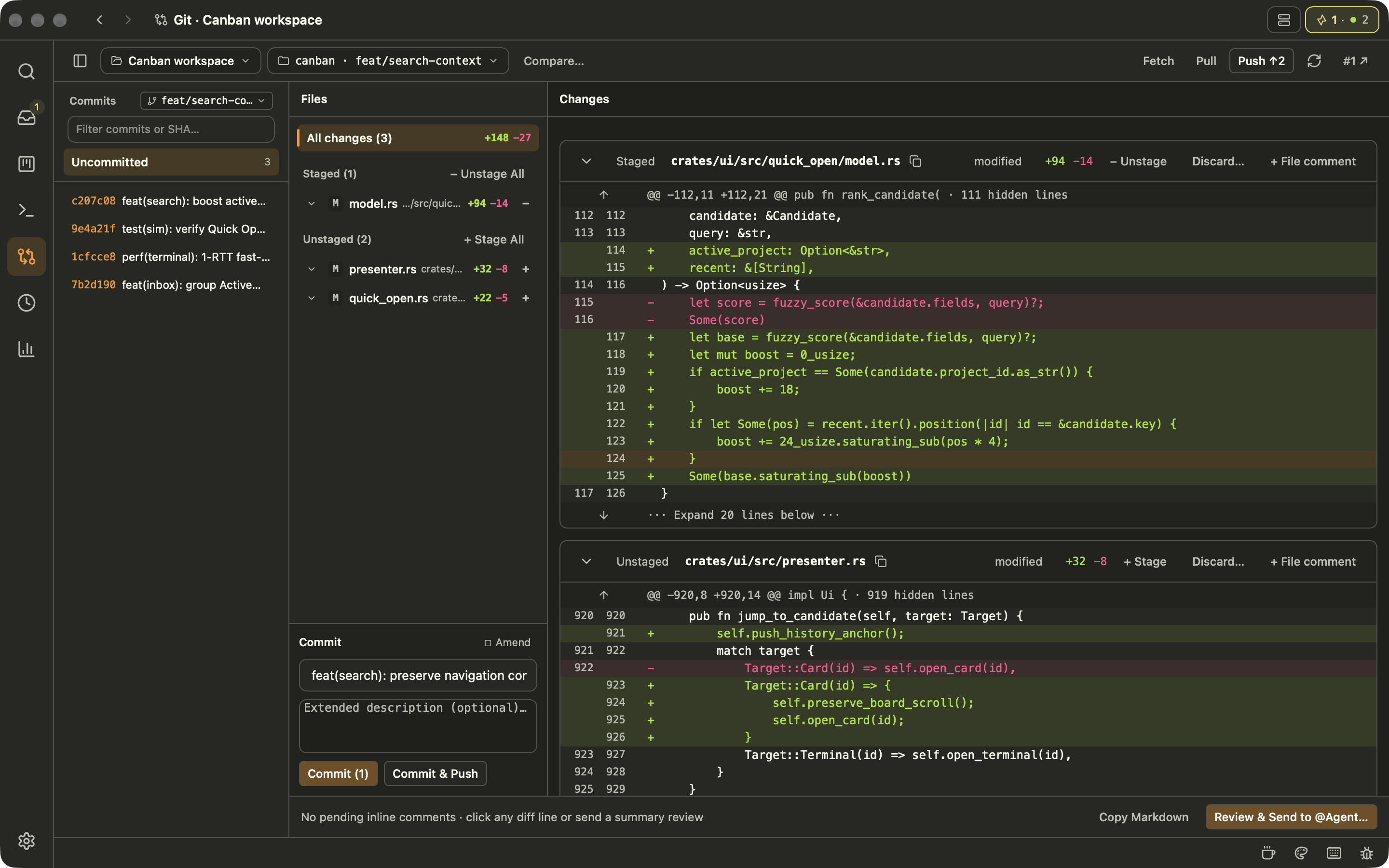
#Cardand GitHub Issue/PR references,@Agentdiscussions, structured reports, and diffs stay together on each Card. - Workflow automates worktrees and delivery: Dragging a Card into
Developallocates an isolated Git worktree (<dir>-<proj4>/<card-number>) and runs your workflow graph;Reviewintegrates changes through a serialized FIFO Queue Merge. - Herdr runs native Agent CLIs without interference: Keep your CLI's native TUI, MCP servers, skills, permissions, and exact-ID session resume intact.
Timeline-first Insights dashboard
Canban's built-in Insights view (1D, 7D, 30D, 90D) measures personal dwell time alongside Agent execution and Kanban delivery across all connected hosts without keystroke hooks or noisy token counters:
1Dhourly swimlanes &7D–90Ddaily comparisons: InspectMe · Card / Terminal / Otherdwell lanes against Agent working lanes (grouped byProfileorModel) and clickableMergesmarkers, with same-progress clock cutoffs (Yesterday so far/Last week/ prior7d–90d).- Automation funnel & zero-human completion rate: Track
Created → Agent → Review → Mergedthroughput, human asks per Card, and the share of Cards resolved without human intervention. - 365-day heatmap &
p50/p90timings: Switch the annual heatmap betweenResolved,My time, andAgent time, drill into slowest-firstExecution → resolutionandQueue → starttimings, and aggregate metrics seamlessly across local and remotecanbandhosts.
Core CLI quickstart
Inside any Canban-launched terminal or scheduled agent session, Canban injects CANBAN_CLI, CANBAN_ENDPOINT, CANBAN_CARD, CANBAN_PROJECT, and CANBAN_RUN_DIR. Add --human for pretty-printed JSON without fetching extra fields.
"$CANBAN_CLI" card show --fields number,title,body,stage,revision
"$CANBAN_CLI" card adopt --stage develop
"$CANBAN_CLI" report --state completed --message 'Implemented and verified tests' --file "$CANBAN_RUN_DIR/report.md"
canban --human --fields number,title,stage card show
See the full Canban CLI, Agent Optimization & --human guide.