One surface for Claude Code, Codex, Gemini, and OpenCode — plan, branch, and review across engines.


Of the agent, By the agent, For the agent
Stop shuttling between tmux panes. tunaFlow is a desktop client that runs multiple CLI coding agents (Claude Code, Codex, Gemini, OpenCode) side by side under a unified Plan → Dev → Review workflow.
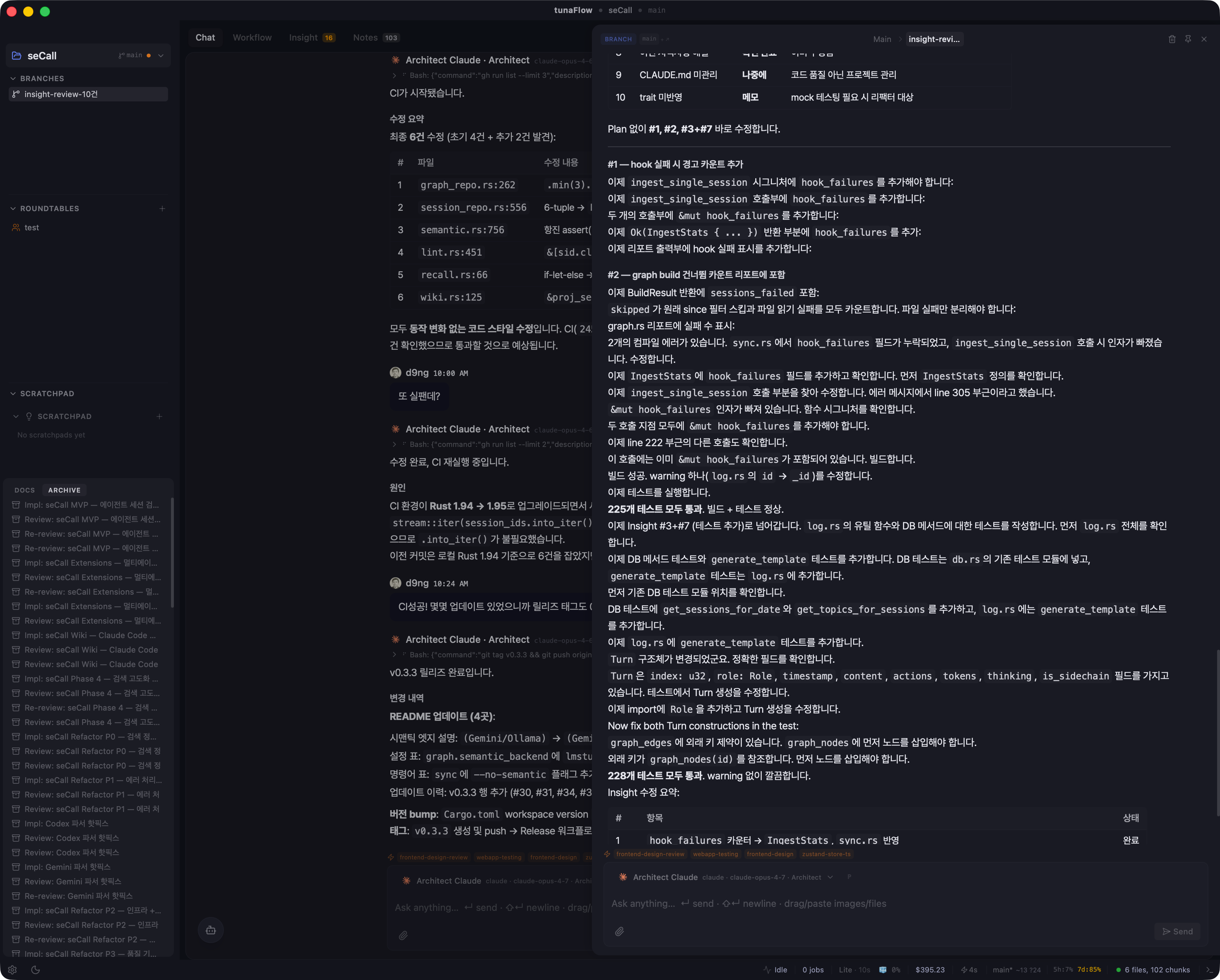
📺 Workflow demo (6 min)
tunaFlow-demo-v2.mp4
- Users of Claude Code, Codex, or Gemini CLI who need structured workflows beyond simple chat.
- Those who want to delegate execution to agents while retaining direction and judgment.
- Small teams or individuals looking to integrate AI agents into their daily development workflow.
tunaFlow started from a concrete pain: running Claude Code, Codex, and Gemini CLI side by side meant constant copy-pasting between tmux panes, iTerm tabs, or terminal multiplexers like cmux. Even when the individual engines were great, the workflow was manual stitching. tunaFlow bundles that stitching into a single surface so the user's attention stays on intent, not on terminal pane management.
The four engines (Claude, Codex, Gemini, Ollama) share a single assembly function, build_normalized_prompt_with_budget(). Since identity, recent context, long-term memory, skills, and tool results are assembled into a consistent ContextPack regardless of the engine, switching engines is a one-line toggle, not a prompt rewrite.
The Plan is drafted by the Architect (Claude Opus) and verified by an independent Reviewer (Codex, blind) using invariant_checks and a 4D rubric (plan_coverage, code_quality, test_coverage, convention). Converging design-phase BLOCKERs reduces the cost of major implementation reworks.
Experiment with the same topic by branching it to multiple agents (Branch). If a result is satisfactory, adopt it—injecting only the summary into the main conversation. Side-branch transcripts do not pollute the main context, maintaining a clean flow of conclusions. Roundtable (RT) is an extension of this Branch model.
The primary execution paths are via Claude Code, Codex, and Gemini CLI. The SDK (API billing) is used only as a fallback. This is designed so users with existing subscriptions can utilize all features without additional token costs.
Output quality comes first. Identity documents, worldview files, and analysis summaries are allowed to be rich (AGENTS.md-level, 1,500–3,000 tokens) when that richness improves agent output. The wasteful axis we do avoid is redundancy — re-injecting context already held in the claude session buffer, stale compression leaking into current requests, or the same information doubled across sections. Here, "lean" means "no redundancy", not "compressed to the minimum".
An Architect → Developer → Reviewer 3-role system.
Once a Plan is designed, the Developer implements it, and the Reviewer performs cross-verification.
If a failure occurs, the system analyzes findings and automatically proposes a rev.N+1 Plan.
- Quick: Fast verification by a single
Reviewer. - Deep: Cross-verification via
Roundtablewith multiple engines + automated test injection. Evaluated based on a 4D rubric (plan_coverage,code_quality,test_coverage,convention) +invariant_checks. TheRevieweris assigned to a different vendor (blind) from theArchitect.
Maintains a persistent session with CLI agents without the need for one-off -p flags. Enables full tool usage (file modification, command execution, etc.). tunaFlow avoids redundant context injection as long as the session is active (via Claude --sdk-url WebSocket path + PTY legacy fallback).
Agents from multiple engines discuss a single topic. Supports Sequential or Deliberative (simultaneous) modes. All RT sessions are extensions of the Branch model.
A common prompt assembly engine for all supported engines (Claude / Codex / Gemini / Ollama / LM Studio). Features automatic Lite / Standard / Full tiering. Includes rawq code search, long-term memory, failure learning, and role documentation in the context.
Analyzes data pre-extracted by rawq and code-review-graph. Covers 6 categories: Stability, Testing, Architecture, Performance, Security, and Tech Debt. Supports automatic Quick Wins fixes.
Automatically detects available agents during initial project setup and recommends an agent configuration suitable for the project stack.
| Engine | Integration Method |
|---|---|
| Claude (Anthropic) | CLI subprocess + WebSocket sdk-session (Persistent Session) |
| Codex (OpenAI) | CLI subprocess + app-server (Stateful thread) |
| Gemini (Google) | CLI subprocess |
| Ollama / LM Studio / vLLM | HTTP SSE (OpenAI-compatible) |
-
macOS (currently macOS only)
-
Node.js 20+
-
Rust stable — if not already installed, one line via rustup:
curl --proto '=https' --tlsv1.2 -sSf https://sh.rustup.rs | sh
source "$HOME/.cargo/env"
(If
npm run tauri deverrors withcargo metadata ... No such file or directory, this is why — Rust / cargo is required by Tauri.) -
At least one agent CLI:
npm install -g @anthropic-ai/claude-code   # Claude
npm install -g @openai/codex               # Codex
npm install -g @google/gemini-cli # Geminigit clone https://github.com/hang-in/tunaFlow.git
cd tunaFlow
npm install
npm run tauri dev./scripts/build.shcurl -fsSL https://raw.githubusercontent.com/hang-in/tunaFlow/main/install.sh | bashAs this uses an ad-hoc signature, a Gatekeeper warning may appear. Clear it with:
xattr -cr /Applications/tunaFlow.app
Tauri 2 + React 18 + TypeScript + Zustand 5 + Tailwind CSS 4 + Rust + SQLite (WAL, v46)
Code Search: rawq sidecar (bge-m3 embedding) · code-review-graph · context-hub
External Integration: HTTP API + WebSocket · MCP Server (tunaflow-mcp)
| Document | Content |
|---|---|
| CLAUDE.md | Architecture, conventions, handoff |
| Architecture Detail | RT flow, Store structure, DB schema |
| Implementation Status | Feature implementation status |
| Beta Release Plan | Deployment readiness checklist |
| Dev History | Project lineage + development history |
| Session History | Detailed session history (for tracking design decisions) |
Written by Claude Opus while building tunaFlow. A candid, first-person account of the design decisions, tradeoffs, and mistakes behind each feature.
- tunaFlow Wiki — full series + side posts
Highlights:
- Why an orchestration layer (agent process split)
- Plan → Dev → Review pipeline
- Branching conversations (adopt model)
- Roundtable — making agents debate
- Long-term memory (brute-force vectors, why not sqlite-vec yet)
- Engine architecture on a Claude Pro ($20) plan
- rawq + code-review-graph sidecars
- Auto-picking skills out of 246
- Breaking the Doom Loop (failure learning)
- Running tunaFlow against itself — a full-cycle retrospective
tunaFlow launches the Claude CLI with the --dangerously-skip-permissions flag. This means the CLI skips approval prompts for file access outside the project directory, system commands, and similar operations.
Your responsibilities:
- Choose the project directory you hand to the agent carefully — it defines the trust boundary.
- Do not enable untrusted prompts, tools, or MCP servers.
- Review the work the agent performed periodically; don't treat autonomous runs as unattended.
Why this flag, and why no UI approval flow: the stream-json protocol does not emit a permission_request event, so there is no way for tunaFlow to intercept prompts and surface them in the UI. The CLI writes prompts directly to the terminal, and tunaFlow holds stdin for outbound messages, so prompts go unanswered — which is exactly the #178 infinite-hang path. Until Anthropic ships a first-class permission event (tracked in postBetaBacklog B-20), --dangerously-skip-permissions is the pragmatic choice.
If this trade-off is unacceptable for your workflow, run Claude Code directly in a terminal instead of via tunaFlow for that task — the permission surface is identical either way, just under your direct interaction.
- PTY Terminal — Work in Progress — The in-app terminal panel is temporarily unavailable in the Beta bundle and is being rewired. Use an external terminal (iTerm2 / Terminal.app / Warp) alongside tunaFlow until a follow-up release restores it.
- JSONL Completion Detection Failure (P1) — Occasional issues where PTY session responses are not reflected in the UI (transitioning to
sdk-sessionWebSocket path). - Windows / Linux builds — Not yet supported; packaging pipeline in progress.
- Ad-hoc Signature — No Apple Developer ID signing in Beta. Requires Gatekeeper bypass (
xattr -cr /Applications/tunaFlow.app). - Limited mid-round RT interruption — participant-level token streaming works in real time, but once a round is in progress, redirecting the discussion mid-round is awkward. Feedback is delivered between rounds.
- Initial Indexing Delay — Large projects may take several minutes for the first run (CPU spikes mitigated via ONNX thread limits, semaphores, and incremental indexing). Build artifact directories (
target/,node_modules/,dist/,.venv/,__pycache__/and similar) are excluded from rawq indexing to prevent OOM — full list and theRebuild indexbutton (for users upgrading from before the exclude list) are documented in rawq-setup.md.
Detailed list: CLAUDE.md §5
Key shortcuts, feature summaries, and troubleshooting tips are available in the Settings > Help panel within the app.
Projects developed using tunaFlow's multi-agent orchestration workflow:
- secall — Hybrid search "second brain" for AI conversations. A CJK-adapted take on Andrej Karpathy's LLM wiki concept.
tunaFlow borrows ideas and code from several open-source projects. Thanks to the following maintainers:
- rawq (MIT) — code-search sidecar. tunaFlow ships a locally-patched build as a bundled binary.
- code-review-graph (MIT) — CRG sidecar (Full track). Graph-based code review analysis.
- context-hub (MIT) — context-sharing sidecar. Auto-installed on first run.
- abtop (MIT) — runtime observability / diagnostics for AI coding agents. Shaped tunaFlow's Trace panel and status bar.
- hermes-agent (MIT) — memory / toolset / iteration-budget patterns.
- larksuite-cli (MIT) — CLI action layering / shared-rule / async-contract patterns.
- chops (MIT) — ContextPack code-slice injection ideas.
- codex (Apache 2.0) — reference implementation for CLI agent protocol work.
- xterm.js (MIT) — terminal rendering in the PTY panel.
- react-markdown (MIT) — chat markdown rendering.
- D2Coding (OFL 1.1) — bundled monospace font.
- Tauri (MIT / Apache 2.0) — desktop shell framework.
See ACKNOWLEDGMENTS.md for the full list of 25+ referenced projects (articles, papers, and indirect influences). Full third-party attribution list is in NOTICE.
- Code Agent Orchestra by Addy Osmani — shaped tunaFlow's multi-agent orchestration philosophy.
- Stavros Korokithakis's Claude Code workflow posts — inspired the
Plan → Dev → Reviewpipeline.
- Email: d9ng@outlook.com
- Issues: https://github.com/hang-in/tunaFlow/issues
- Security: see SECURITY.md
100% AI-authored codebase — Claude Code wrote every line; humans provide architecture and direction.
🇺🇸 English · 🇰🇷 한국어