
noirvpn implements the OpenVPN layer-3 tunnel protocol as a client for Linux, Windows and macOS, and as a server for Linux. It connects to OpenVPN 2.6 and 2.7 servers, accepts OpenVPN 2.6 and 2.7 clients and reads OpenVPN configuration files. It is an independent implementation, written from scratch in Odin and licensed under Apache-2.0.
noirwindowsdemo.mp4
noir client on Windows connecting to OpenVPN server and noir server
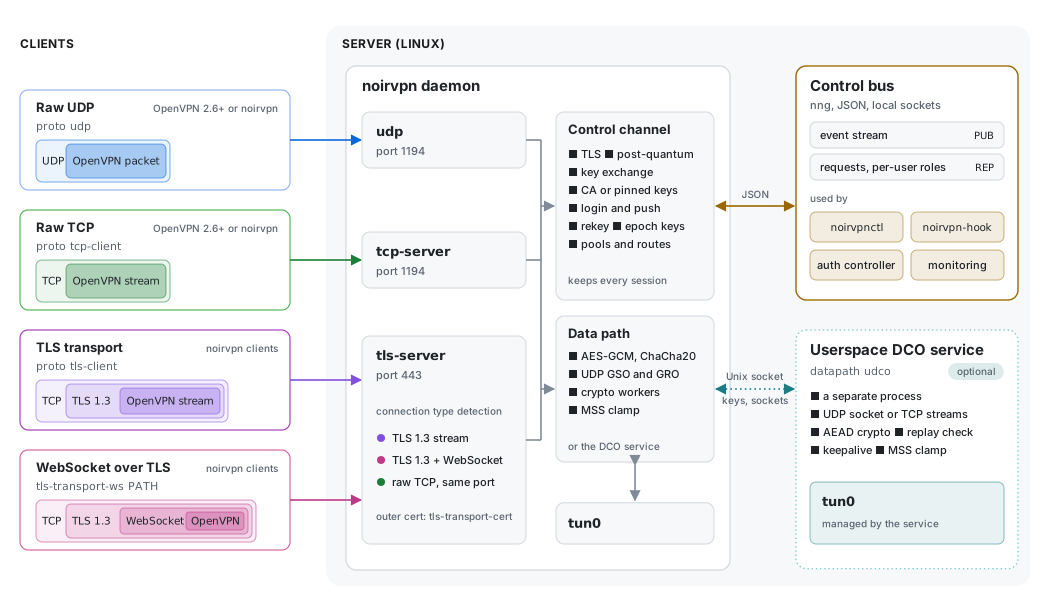
The programs:
| Program | Systems | Use |
|---|---|---|
noirvpn |
Linux, macOS, Windows | The VPN daemon: client and server (server on Linux only). |
noirvpnctl |
Linux, macOS, Windows | CLI to control a running daemon from the shell: status, peers, profiles, connect and disconnect. |
noirvpn-hook |
Linux | Run commands on daemon events; does not need root. |
noirvpn-desktop |
Linux, macOS, Windows | The graphical desktop app, using SDL3 rendering. It has a profile manager and interacts with noirvpn client. |
TCP inside the tunnel with one iperf3 stream. Other than WireGuard which uses ChaCha20-Poly1305, the data cipher is AES-256-GCM. The numbers show the received rate in Gbit/s; "up" means the client host transmit.
| Implementation | UDP up | UDP down | TCP up | TCP down |
|---|---|---|---|---|
| OpenVPN 2.7.7, userspace | 0.72 | 1.22 | 0.84 | 1.15 |
| OpenVPN 2.7.7, kernel DCO | 4.23 | 4.18 | 4.31 | 4.58 |
| noirvpn, userspace | 8.34 | 6.98 | 4.91 | 5.17 |
noirvpn, userspace, workers 2 |
12.19 | 9.42 | 6.01 | 6.66 |
| WireGuard, kernel | 7.09 | 5.42 | n/a | n/a |
- Without workers, noirvpn runs the data path in one thread. With
workersit performs crypto on separate threads. - WireGuard has no TCP transport.
Test setup (2026-11-20):
- Two VMware ESXi virtual machines with 4 vCPUs of an AMD Ryzen 9 5900X and 3.9 GiB of memory each, Alpine Linux (musl), Linux 6.18, OpenSSL 3.5.
- Networking: ConnectX-5 virtual functions between them, 30 Gbit/s raw.
- tls-crypt on all OpenVPN and noirvpn tunnels. Tunnel MTU is 1400 for noirvpn, 1428 for OpenVPN and 1420 for WireGuard.
Smaller surface. Noir keeps the parts of OpenVPN that current
deployments use. It removes compression, static-key mode, tap and bridging, and
peers older than OpenVPN 2.6. Run noirvpn --check-config to see what happens
to each line of your configuration before you start the daemon. The
option reference lists every option it supports.
A control bus instead of scripts and plugins. Built on nng, the bus replaces scripts, plugins and the management interface. It has a stream of JSON events and a request channel with per-user roles.
- Monitoring tools subscribe to the events.
- A controller decides each client login (
auth-external) with your own implementation. noirvpnctlcontrols a daemon from the shell. Withclient-service, a user without root privileges loads a profile and connects throughnoirvpnctl(see Service mode).noirvpn-hookcan be used to run commands on events without root.
TLS transport. proto tls-client and proto tls-server send the
OpenVPN TCP stream inside TLS 1.3, so the tunnel looks like HTTPS.
- One port serves both the TLS transport and plain OpenVPN TCP clients.
- HTTP proxy support in the client (CONNECT, Basic authentication).
- WebSocket framing support in the server, with reverse proxies that forward them using HTTP.
- The inner OpenVPN session establishes the session trust; the client can detect if someone terminated the encapsulating TLS transport on the way.
Pinned keys instead of a CA. A server can accept clients by the key they
present by storing the keys in the (peer-keys) file, with or without
a certificate authority.
Post-quantum key exchange by default. hybrid X25519MLKEM768 preferred.
A fast data path in userspace. The data channel uses only AEAD ciphers (AES-GCM and ChaCha20-Poly1305) and the epoch data keys of OpenVPN 2.7, supporting both UDP and TCP connections.
Kernel data channel offload. With datapath dco, noirvpn passes the data
channel to the ovpn module of the Linux kernel (Linux 6.16 or later).
An open data channel offload interface. With datapath udco, noirvpn
passes the data channel to a separate userspace DCO service over a documented
local socket protocol. noirvpn will handle the control channel while the service
passes the packets.
See build/README.md for build instructions.
A client with a CA, a certificate and a tls-crypt key:
client
dev tun
proto udp
remote vpn.example.com 1194
ca ca.crt
cert client.crt
key client.key
tls-crypt tc.key
A server for that client:
dev tun
proto udp
port 1194
server 10.8.0.0 255.255.255.0
topology subnet
ca ca.crt
cert server.crt
key server.key
tls-crypt tc.key
keepalive 10 60
Check the configuration. Then start the daemon as root or with CAP_NET_ADMIN:
noirvpn --check-config --config client.conf
noirvpn --config client.conf
For the tls transport, set proto tls-client and a remote on port 443 on the
client. On the server, set proto tls-server and port 443.
Control a running daemon:
noirvpnctl status
noirvpnctl peers # on a servernoirvpn can read the server and client configuration without change most of the time. Follow the steps below to ensure that they are compatible.
-
Check the configuration you have:
noirvpn --check-config --config server.conf. Each line shows as supported, ignored (a warning) or rejected (the server does not start), with the replacement. -
Replace the rejected options:
OpenVPN noirvpn client-connect,client-disconnect,learn-address,up,downand other scriptsEvents on the control bus, or noirvpn-hookauth-user-pass-verify,tls-verify,pluginpeer-passwords,peer-keysorauth-externalmanagement,statusnoirvpnctl status,noirvpnctl peers,stats-intervalclient-cert-not-required,verify-client-cert noneverify-client-cert optionalwithpeer-passwordsorauth-externalcompress,comp-lzoRemove: there is no compression dev tap,server-bridgedev tun: layer 3 onlytopology net30,topology p2ptopology subnetpkcs12,pkcs11-*PEM files -
Start the daemon as root or with
CAP_NET_ADMIN:noirvpn --config server.conf. Watch it withnoirvpnctl statusandnoirvpnctl peers. -
Add the noirvpn options you want (all optional):
| Option | Values | Default | Use and example |
|---|---|---|---|
peer-keys |
file path | - | Peers file: one pinned client key per line. Clients need no CA.peer-keys /etc/noirvpn/peersA line: alice sha256:EEdckfvr1RFz...= ifconfig-push=10.8.0.10 |
peer-keys-mode |
pin, both, either |
pin |
both: a CA chain and a pin. either: a pin, else a CA chain. Both need ca and peer-keys.peer-keys-mode either |
peer-passwords |
file path | - | User names and password hashes; the server checks client passwords itself.peer-passwords /etc/noirvpn/usersA line: alice<TAB>pbkdf2-sha256:260000:<salt>:<hash> |
auth-external |
seconds (optional) | off | A controller on the control bus decides each login, within the timeout.auth-external 30 |
auth-web |
none | off | Web sign-in through the controller. Needs auth-external and verify-client-cert optional.auth-web |
pq-mode |
off, prefer, require |
prefer |
Hybrid post-quantum key exchange (X25519MLKEM768).pq-mode require |
datapath |
userspace, dco, udco, auto |
userspace |
Who moves the packets: this process, the Linux ovpn kernel module (6.16 or later), a userspace DCO service, or the best one available.datapath auto |
dco-socket |
socket path | /run/udco/udco.sock |
Socket of the DCO service, for datapath udco or auto.dco-socket /run/udco/udco.sock |
workers |
number of threads | 0 (none) |
Crypto worker threads; clients are spread over them.workers 4 |
connect-freq-source |
number | 20 |
Initial replies for one source address in the connect-freq-initial window (0: no limit).connect-freq-source 20 |
stats-interval |
seconds | off | Send a stats.tick event on the bus every n seconds.stats-interval 10 |
bus-control |
off, or path [mode M] [group G] |
/run/noirvpn/<config name>.control |
The control socket for noirvpnctl and controllers.bus-control /run/noirvpn/server.control mode 0660 group noirvpn |
bus-events |
off, or path [mode M] [group G] |
/run/noirvpn/<config name>.events |
The events socket for monitors and noirvpn-hook.bus-events /run/noirvpn/server.events mode 0640 group noirvpn |
bus-allow |
uid, gid or sid, an id, roles |
- | Who may use the control socket, and with which roles. One line per rule.bus-allow uid 0 adminbus-allow gid noirvpn read |
proto tls-server |
value of proto |
- | The tls transport: OpenVPN TCP inside TLS 1.3, for noirvpn clients.proto tls-server with port 443 |
tls-transport-accept-tcp |
none | off | A tls-server port also accepts plain OpenVPN TCP clients.tls-transport-accept-tcp |
tls-transport-cert, tls-transport-key |
file path | cert, key |
Certificate (leaf first, then the chain) and key of the outer TLS.tls-transport-cert /etc/noirvpn/tls.crttls-transport-key /etc/noirvpn/tls.key |
tls-transport-ws |
URL path | off | Serve the tls transport over WebSocket at this path, for a reverse proxy.tls-transport-ws /vpn |
tls-transport-dev |
device name | dev name + -tls |
Second tun device for tls clients under datapath dco or udco.tls-transport-dev tun0-tls |
Server lists every difference, and the option reference gives the status of each OpenVPN option.
| Directory | Content |
|---|---|
cmd/ |
The command-line programs. |
desktop/ |
The desktop app. |
engine/ |
The daemon core: sessions, data path, client service, tls transport. |
client/, server/ |
Client and server logic: routes, DNS, address pools, peer authentication. |
proto/ |
The OpenVPN protocol: config parser, packet formats, reliability layer, keys, TLS and data channel crypto. |
bus/ |
The control bus: JSON events and requests over nng (named pipes on Windows). |
platform/ |
System interfaces: tun devices, sockets, netlink, kernel DCO. |
docs/ |
Project and user documentation. |
examples/ |
A sample auth-external controller in Go and a script that makes a test key, its certificate and its peer-keys line. |
build/, packaging/ |
Build harness: Windows installer, Linux and macOS service files. |
| Document | Content |
|---|---|
| Usage | Starting the service by hand on Linux for the desktop app. |
| Client | Configuration, identities, routes, DNS, logs and status. |
| Server | Configuration, listeners, addresses, per-client settings, data path, service use. |
| The tls transport | TLS 1.3, HTTP proxies, WebSocket, ClientHello profile, nginx. |
| Management interface | Events, requests, roles, external authentication, noirvpnctl, noirvpn-hook. |
| Userspace DCO interface | The socket protocol for implementers of a DCO service. |
| Option reference | Every option and what noirvpn does with it. |
noirvpn runs on Linux. On Windows it runs as a client, in a console or as a service (see the client on Windows). On macOS it runs as a client under sudo: it makes its own utun interface and uses ifconfig, route and scutil, with no Network Extension (see the client on macOS).
Copyright 2026 Cosinium. Licensed under Apache-2.0; see LICENSE and NOTICE.
The name noirvpn is used for this product (noir meaning black, as the tunnel is a blackbox to an outsider); it has no association with any service that might use the same name.
"OpenVPN" is a trademark of OpenVPN Inc. noirvpn is not affiliated with OpenVPN Inc. and uses the name only to describe protocol compatibility.