See what your software does to S3. sonde records a program's object-storage requests through a local endpoint and reads them as operations — an Iceberg commit, a SlateDB manifest write, a multipart upload — with what stands out, what it cost, and whether the program survives when the store misbehaves.
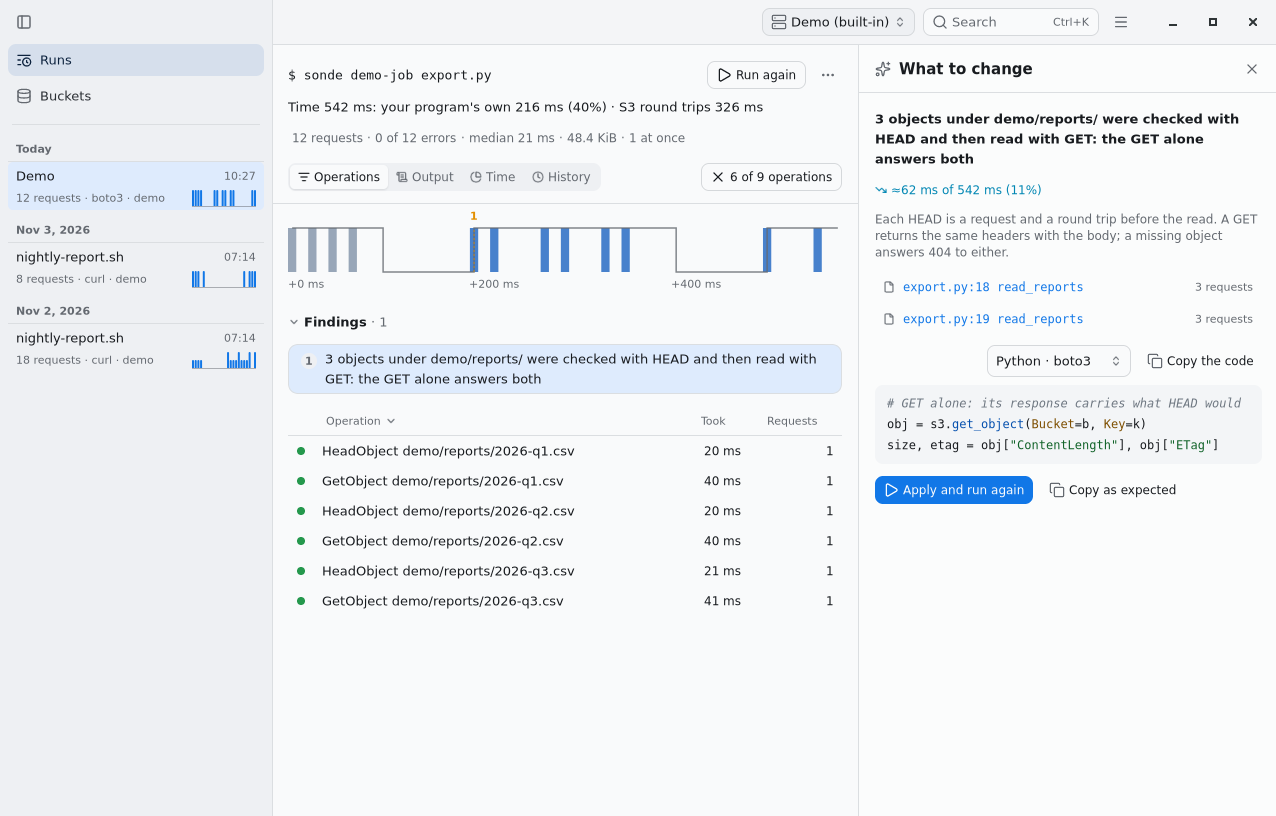
| Record | sonde run -- <command> records every S3 request the program makes. |
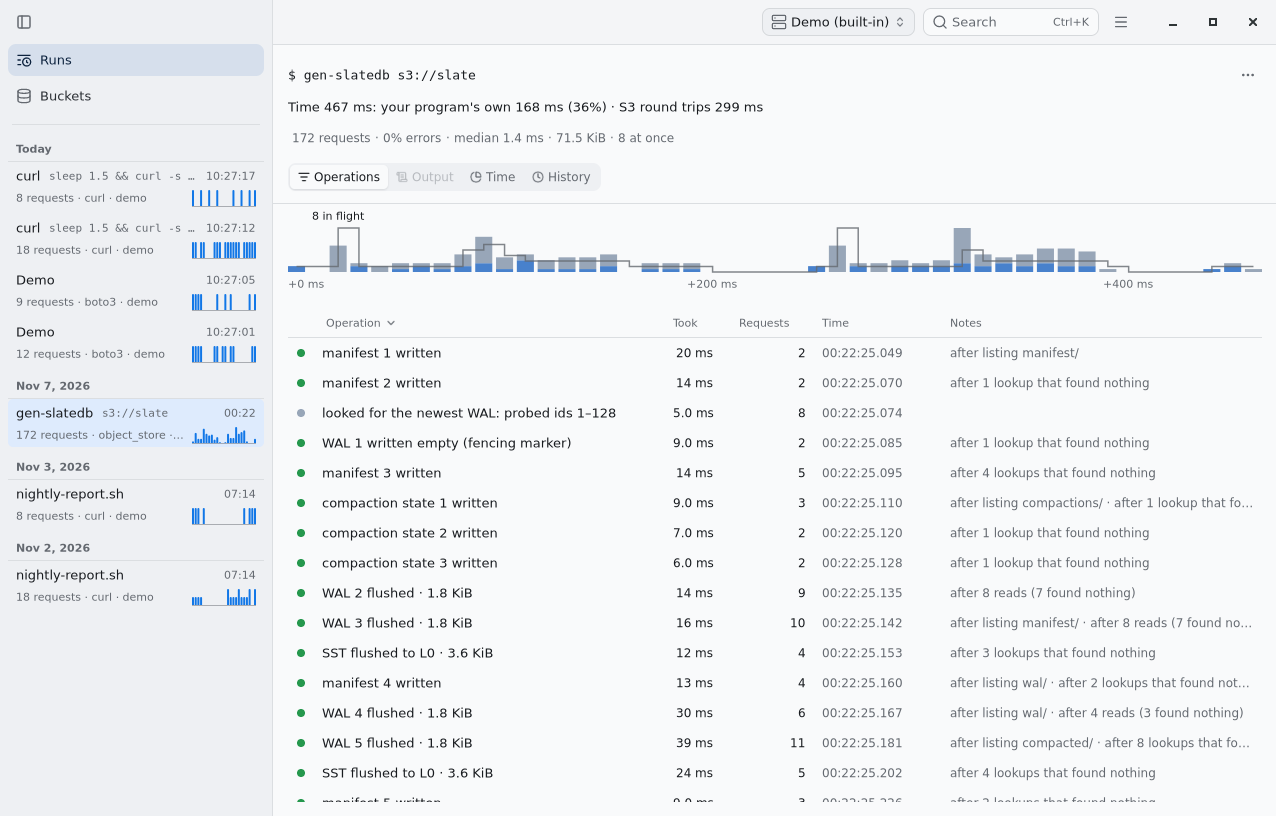
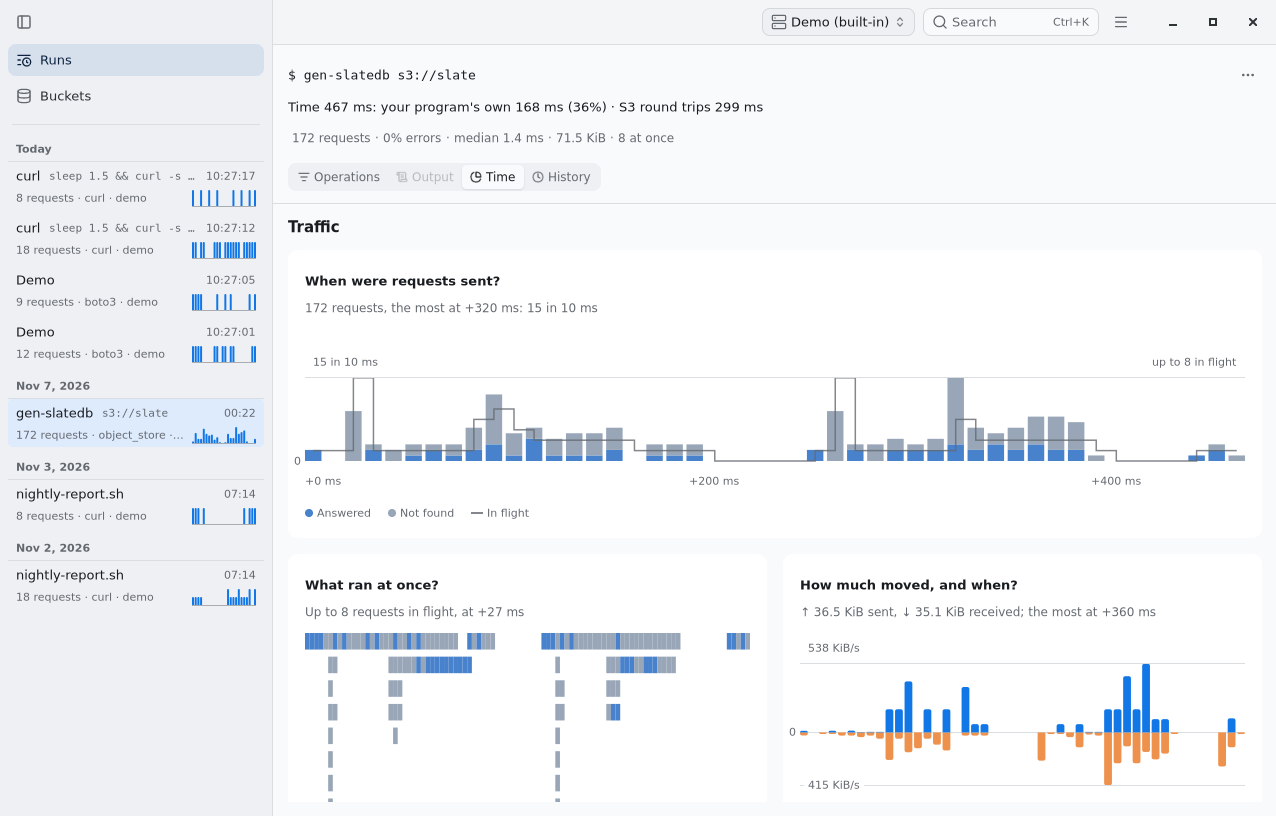
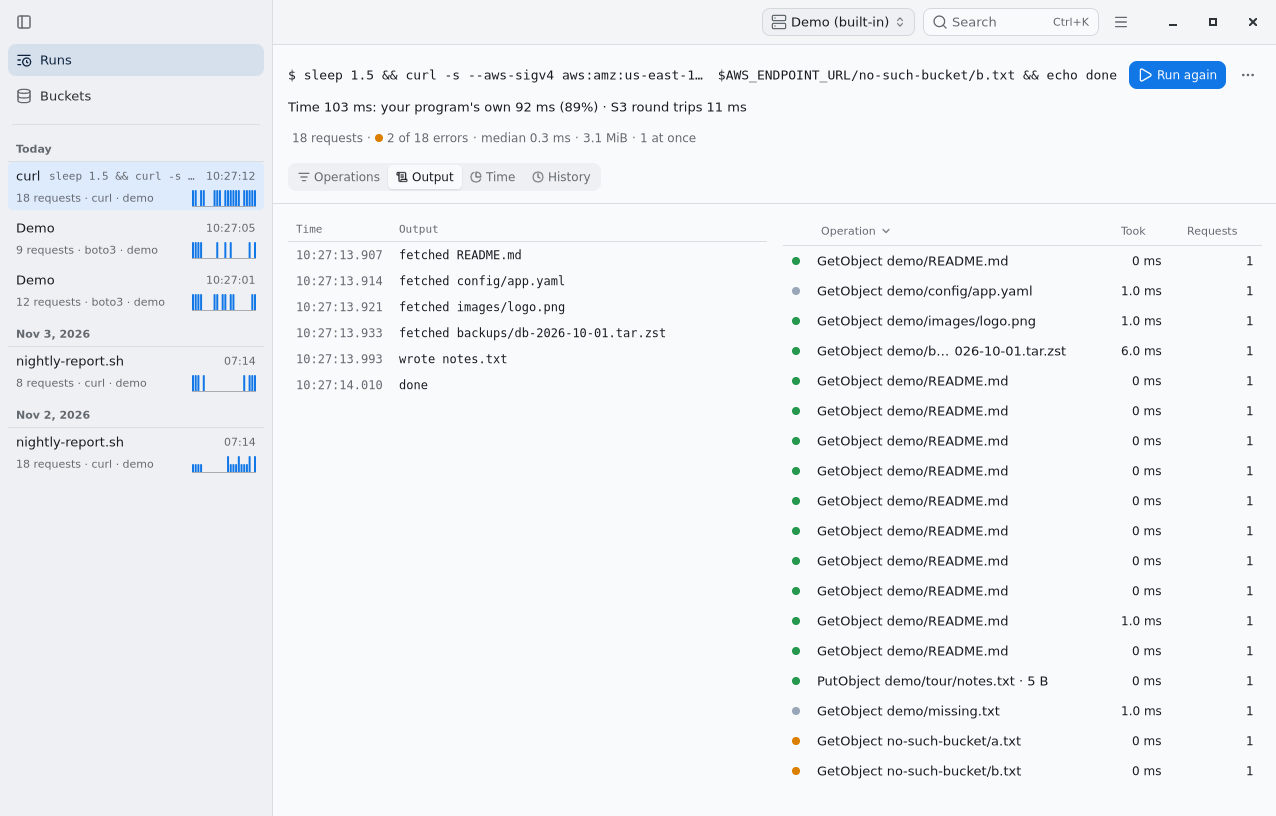
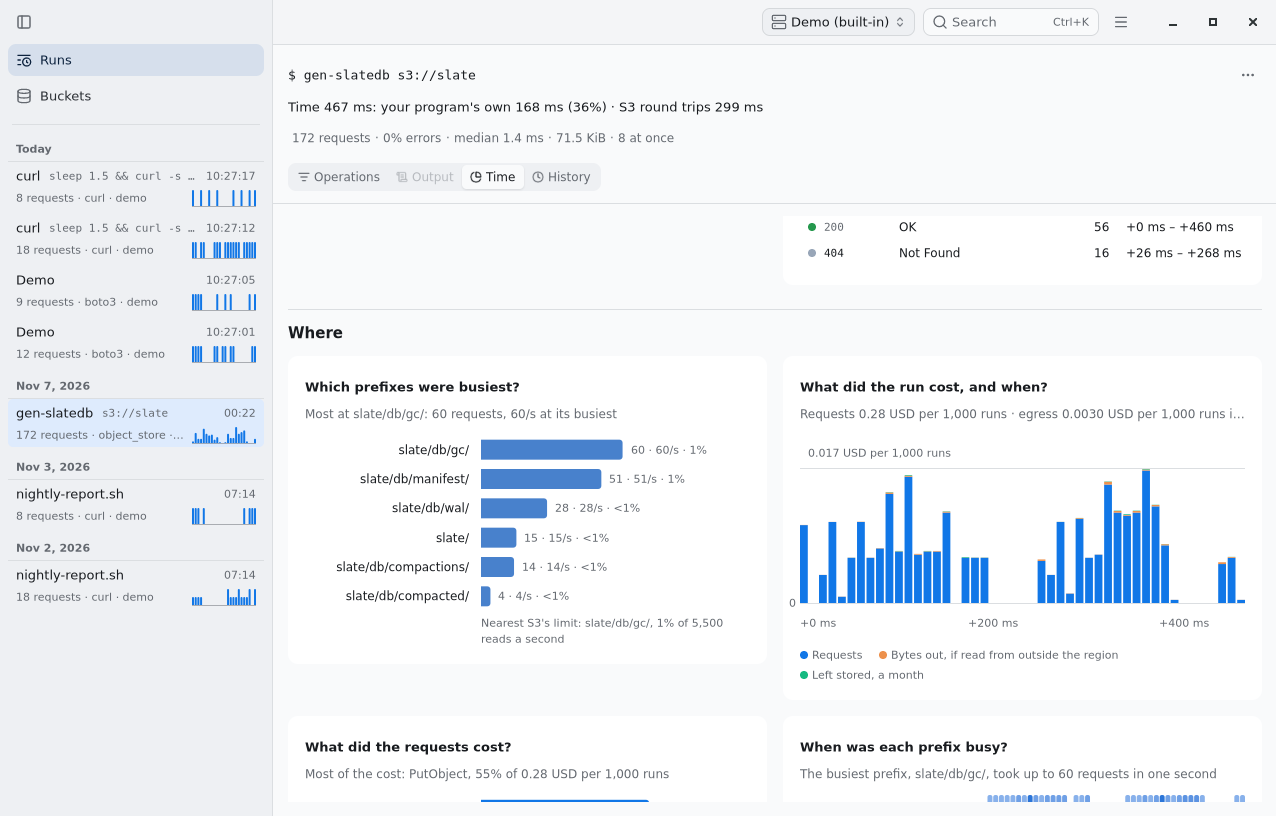
| Read | Requests become operations: multipart uploads, retries, listings, the commits of Iceberg, Delta, Hudi, Paimon, SlateDB and Lance. A table per operation (count, errors, p50/p95/p99) and charts over time. |
| Find and fix | Hot keys, small files, deletes one at a time, writes back with no If-Match, a missing key polled, HEAD before GET, throttling, orphaned files, rename-based commits, requests one after another — each with what fixing it saves, a fix for your SDK and the line that sent it. Run again: the run's time against its own noise, and each finding fixed (with the requests saved and the time predicted), less, more or new. |
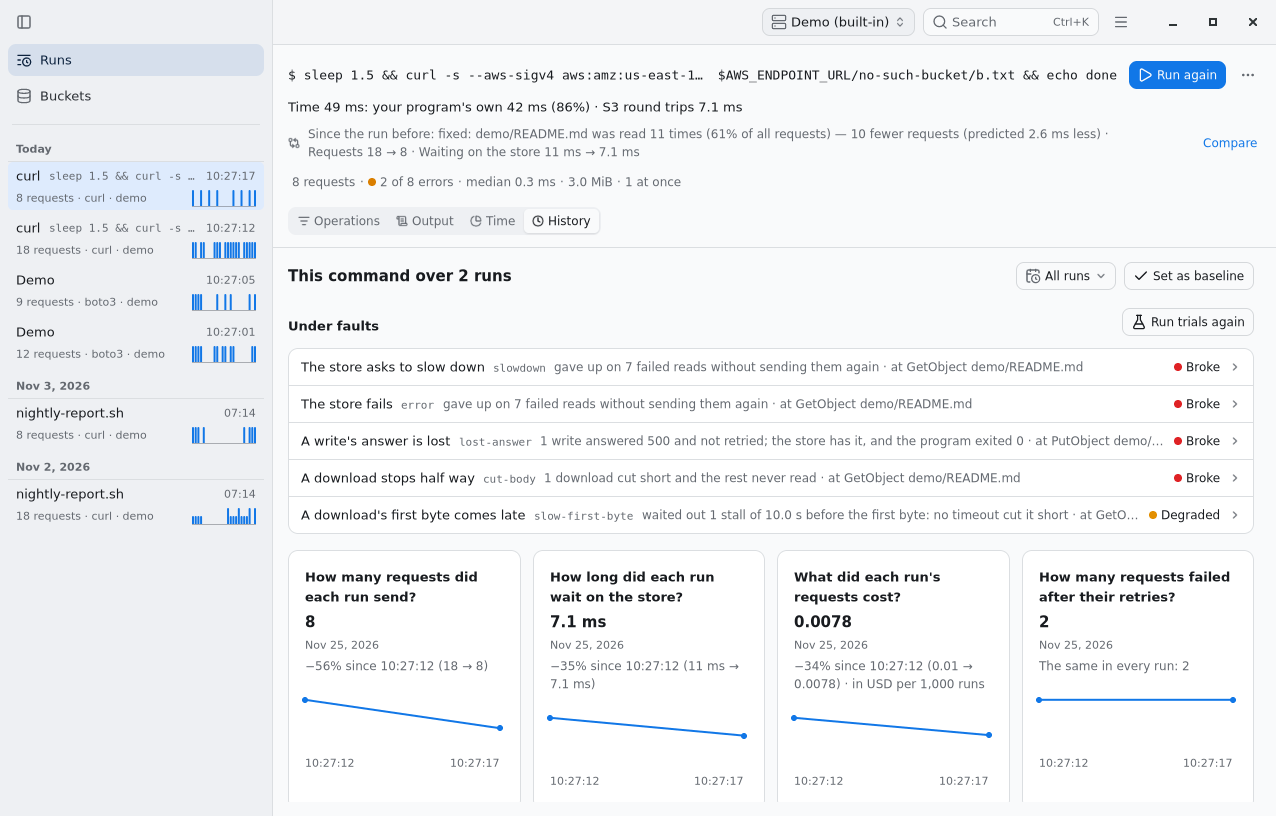
| Try under faults | --trial runs the program again while sonde answers 503s, lost answers, cut downloads, clock skew, stale listings… and says whether it survived, degraded or broke, and what to change: what did not survive is a finding, fixed once it does. |
| Gate CI | sonde check fails a job over its budget or its baseline; the GitHub Action (hxddh/sonde@v34) keeps one PR comment with what changed and a link to the report (ci). |
| Why slow, why costly | show --by kind|prefix|size|caller|key splits the table and says where the slow and costly requests are. |
| Compare and replay | show --since another run, or replay a run on another store to see where answers differ. |
| Import | S3 access logs, CloudTrail and HAR files read the same way. |
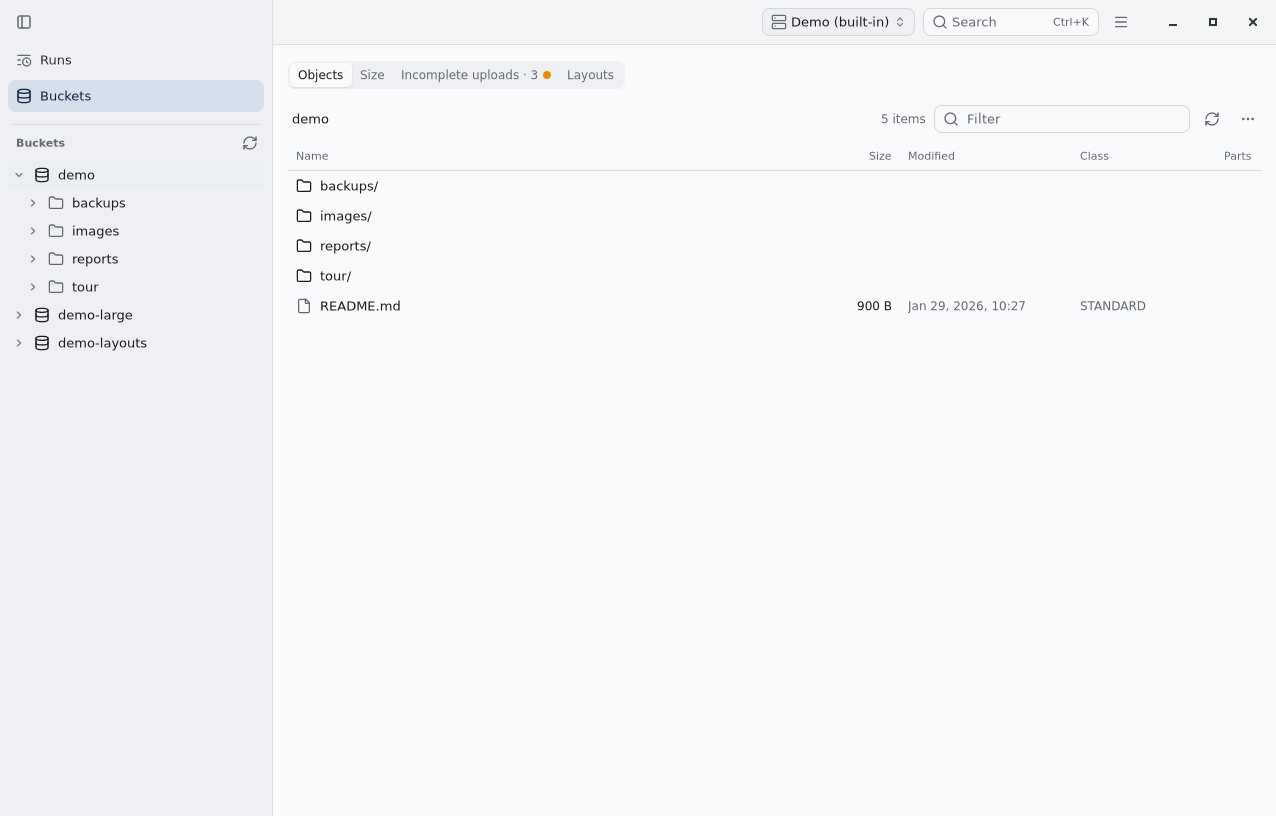
| Look at stores | Browse buckets, find incomplete uploads, run 52 compatibility probes on an endpoint (endpoints test --probes), decode table layouts. |
A desktop app (macOS, Linux, Windows) and a CLI, in English and Chinese.
 |
 |
 |
 |
 |
 |
- Building on S3: what a lake engine or SDK really sends, and why it is slow or costly.
- Before production: does the program retry, back off and finish its commits when the store fails?
- In CI: catch a change that doubles requests or latency before it ships.
- Choosing a store: how another store answers your traffic, against AWS's behaviour (CI runs the probes and replays against RustFS and Ceph).
- After an incident: read production access logs as operations.
program ──(AWS_ENDPOINT_URL, a key of sonde's)──▶ sonde on 127.0.0.1 ──(your real credentials)──▶ S3
                                                        │
                                                        └─▶ the run's file (.sonde): one line per request
- sonde starts an endpoint on loopback and runs the program with
AWS_ENDPOINT_URLand a key made for that run. It checks the program's signature, signs again with your real credentials and forwards the request. The real credentials never reach the program. - A run keeps each request's method, key, headers, status, timing and size — never object data.
- Analysis is in Rust and reads a run as a stream. In a trial, sonde answers chosen requests itself.
- The program needs an S3 client that honours
AWS_ENDPOINT_URL(current AWS SDKs and CLI do; Spark, Flink and containers are configured by sonde; others are said when nothing reaches sonde, recording). The app is built on Native Shell.
More: architecture, security.
curl -fsSL https://raw.githubusercontent.com/hxddh/sonde/main/install.sh | sh # Linux, macOSOr download from Releases: terminal binaries for Linux, macOS and
Windows; the app as .dmg, a Linux tarball (GTK 4) and a Windows zip. Checksums in SHA256SUMS.
One binary, needing only the C library (on Linux glibc 2.35+; on musl or older glibc, the static x86_64 build, which
install.sh picks).
sonde run --demo                        # the tour: a finding, its line of code, its fix, the fix measured
sonde run -- python etl.py              # your program's requests, sent on with your AWS credentials
sonde run -- python etl.py              # after a change: what is fixed, and what it saved
sonde run --trial -- python etl.py 's3://scratch/{trial}/'   # the same under faults
sonde check --init && sonde check       # a budget for CI
No account: --demo runs against a built-in store. Another store: sonde endpoints add ID URL, or --url URL for
one run.
Every command, its formats and exit codes: docs/cli.md.
- What a recorded program may do: everything it would do without sonde. A trial records under
no-delete(no deletes but of what it made, no aborts, lifecycle or bucket policy changes, no suspending versioning);--policychooses (recording). A safety net, not a sandbox: the program runs with your rights (security). - A trial runs the program again, once per scenario: point it at scratch paths with
{trial}in a key, or every run writes over the last (trials). - sonde's own destructive actions (aborting uploads, deleting versions) are each a dry run, then
--yes, and are written to an audit log. - Not supported yet: S3 Express One Zone (refused with a reason), SigV4a, HTTP/2 to the endpoint.
- Memory grows with a run's requests (what a million cost).
- No telemetry. Credentials stay in sonde, and every record is redacted of secrets;
share --redactalso hides bucket and key names. - What is stable between versions — run files, JSON outputs,
sonde.tomlandconfig.toml(configuration), flags, exit codes — is in docs/contract.md.
CLI · For coding agents · CI · Recording · Trials · Configuration · Credentials · Security · Contract · Probes · Decoders · Changelog
To build, test or release sonde: CONTRIBUTING.md, and for contributors docs/dev (run format, architecture, performance, packaging, decisions).
Apache-2.0.