





Drop-in replacement for go tool cover -html.
The coverage Go module renders an HTML file for each *.go source file listed in the specified Go test coverage profile file (typically created per an invocation of go test -coverprofile).
The program expects the specification of three flags with corresponding arguments (see usage below):
-gomod         # path to a go.work file or a comma-delimited list of go.mod paths (default "go.mod")
-coverprofile  # path to the coverage profile file
-outdir        # path where HTML files will be written
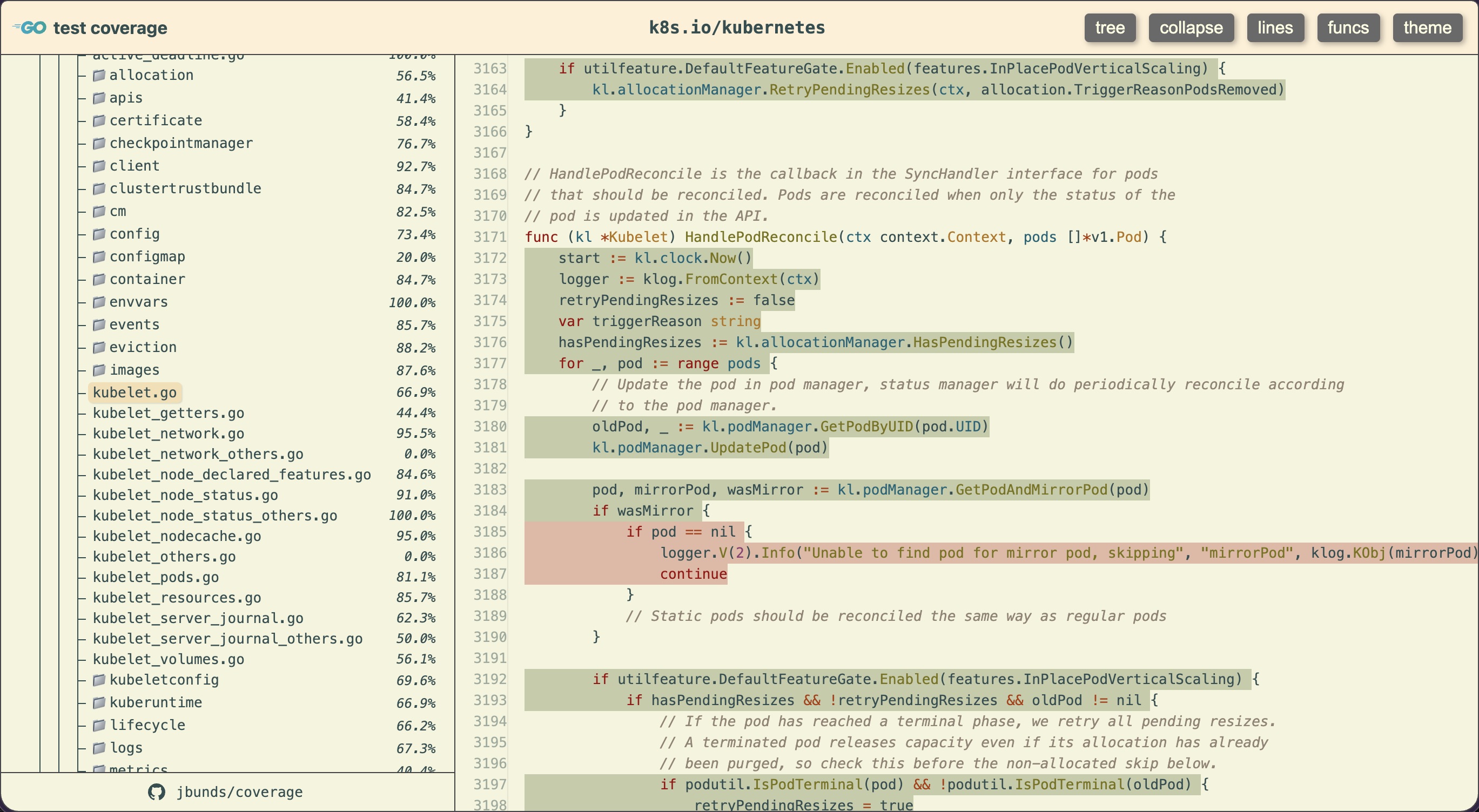
The generated HTML files are marked up to identify which statements are covered by tests (green), and which statements are not (red). Each HTML file is written to the specified path (per the -outdir flag) following the same directory structure as the source from which the coverage profile file (per the -coverprofile flag) was created.
The program then renders an index.html file to the specified path which provides a navigable view of the source rendered as a directory tree on the left, where each node is either a subdirectory (📁 <subdirectory>) or a source file (<source file>.go). Clicking on a subdirectory node expands its contents, and clicking on a source file node renders the marked up source in a child iframe positioned to the right of the directory tree.
The rendered HTML files can be viewed in a browser, either directly via the file:// scheme, or via an HTTP server using the http:// scheme.
When served via HTTP to a browser with JavaScript enabled, buttons are available to:
 toggle between showing or hiding the source tree pane
 toggle between a fully-collapsed and fully-expanded source tree
 toggle between showing or hiding a column of line numbers along the left side of the source code
 toggle between showing or hiding the bodies of all top-level functions and methods in the source code
 toggle between light and dark themes
See also  and

demo.mp4
light theme:
dark theme:
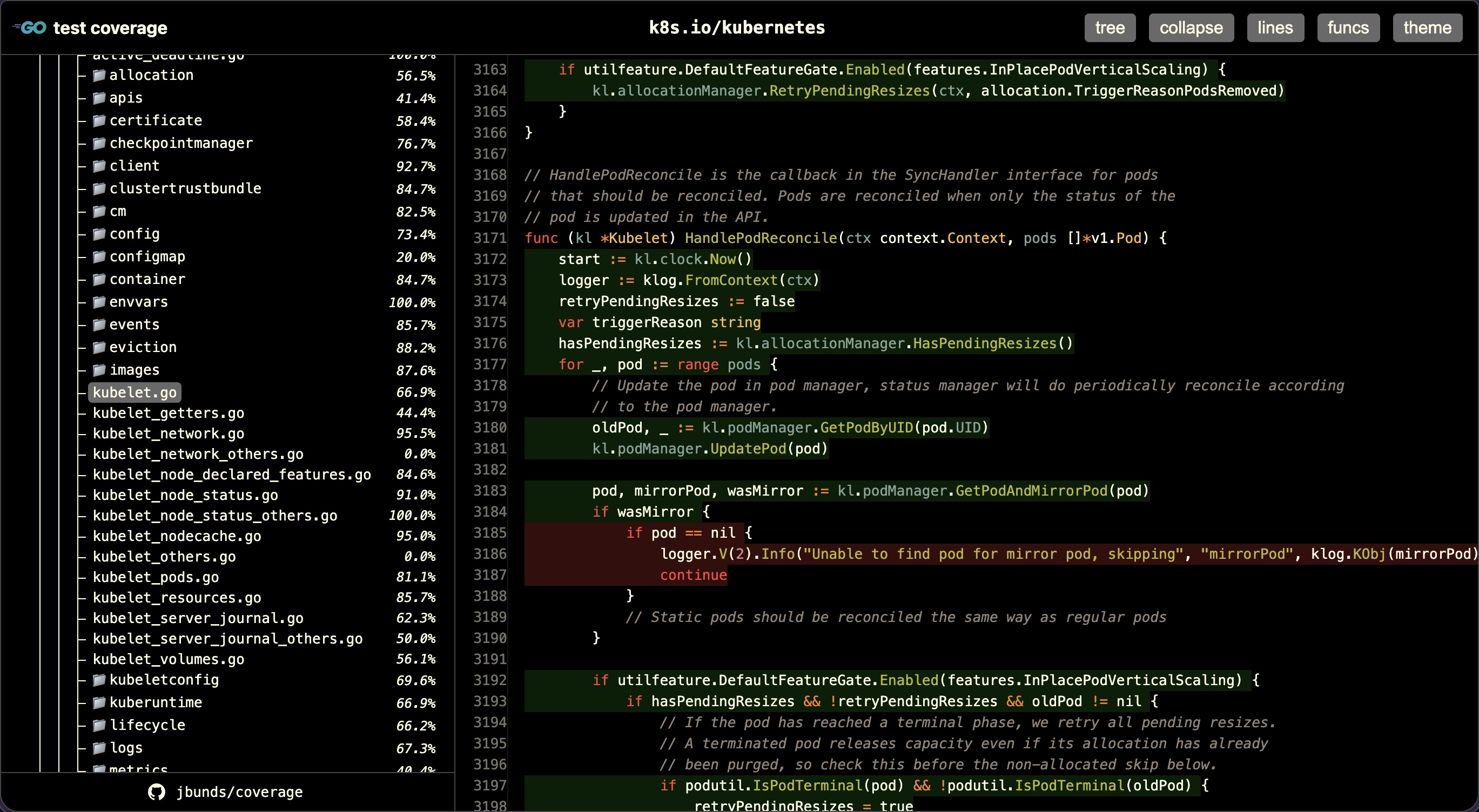
The well-known and relatively large (~4.0M LoC, ~13,600 Go files, ~3,250 packages) Kubernetes project was chosen for the demo to illustrate the features and performance.
$ go install github.com/jbunds/coverage@latest

$ go run github.com/jbunds/coverage
coverage usage:

  -coverprofile string
    	path to the coverage profile file
  -gomod string
    	path to a go.work file or a comma-delimited list of go.mod paths (default "go.mod")
  -n	suppress opening the browser (overrides -s)
  -order value
    	per-file coverage stdout rows sort order
  -outdir string
    	path where HTML files will be written
  -s	serve the generated HTML via a Python HTTP server
Aside from the CLI interface outlined above, there are two ways to incorporate the coverage module within GitHub workflows:
-
The
jbunds/coverage@v1reusable GitHub Action generates the test coverage report and writes the files comprising the report tocoverage-report-outdir. For example:- uses: jbunds/coverage@v1 with: go-mod: 'go.mod' # optional; default is 'go.mod' test-pkgs: './...' # optional; default is './...' cover-pkg: './...' # optional; default is './...' coverage-threshold: '50' # optional; default is '0' coverage-report-outdir: 'coverage_report' # optional; default is 'coverage_report'The
go-mod,test-pkgs,cover-pkg,coverage-threshold, andcoverage-report-outdirparameters are all optional.All outputs produced by the
gwatts/go-coverage-actionworkflow step are available downstream via JSON decoding, e.g.:${{ fromJson(steps.coverage_report.outputs.all).gcov-pathname }} ${{ fromJson(steps.coverage_report.outputs.all).report-pathname }} ${{ fromJson(steps.coverage_report.outputs.all).coverage-pct }} ${{ fromJson(steps.coverage_report.outputs.all).coverage-pct-1dp }} ${{ fromJson(steps.coverage_report.outputs.all).meets-threshold }}etc.
See
jbunds/progress/.github/workflows/test-go.ymlfor a working example. -
The
jbunds/coverage/.github/workflows/pages.yml@v1reusable GitHub Workflow generates the test coverage report and deploys it to GitHub Pages. For example:- uses: jbunds/coverage/.github/workflows/pages.yml@v1 permissions: contents: write # required by gwatts/go-coverage-action to execute `git push origin refs/notes/gocoverage` pages: write # required by actions/deploy-pages id-token: write # required by actions/deploy-pages with: go-mod: 'go.mod' # optional; default is 'go.mod' test-pkgs: './...' # optional; default is './...' cover-pkg: './...' # optional; default is './...' coverage-threshold: '50' # optional; default is '0' coverage-report-outdir: 'coverage_report' # optional; default is 'coverage_report'See
jbunds/progress/.github/workflows/pages.ymlfor a working example.See jbunds.github.io/coverage/ (multi-module) or jbunds.github.io/progress/ (single-module) for example HTML reports uploaded to Pages.
The motivation behind the coverage module is to provide a richer UI than that produced by go tool cover -html, with minimal JavaScript (74 lines in total as of this writing, most of which is either trivial button event-listener boilerplate used to toggle CSS selectors, or theme and line numbers user preference persistence).
The CSS code (350 lines in total as of this writing) was inspired by and adapted from github.com/psnet/simple-tree, and it could probably benefit from further refinement. But I am not a CSS expert, and it fulfills the required behavior as-is.
go-better-html-coverage is similar but provides a much richer UI afforded by its extensive use of JavaScript. I couldn't get it to work with the Kubernetes codebase.