Catalogue
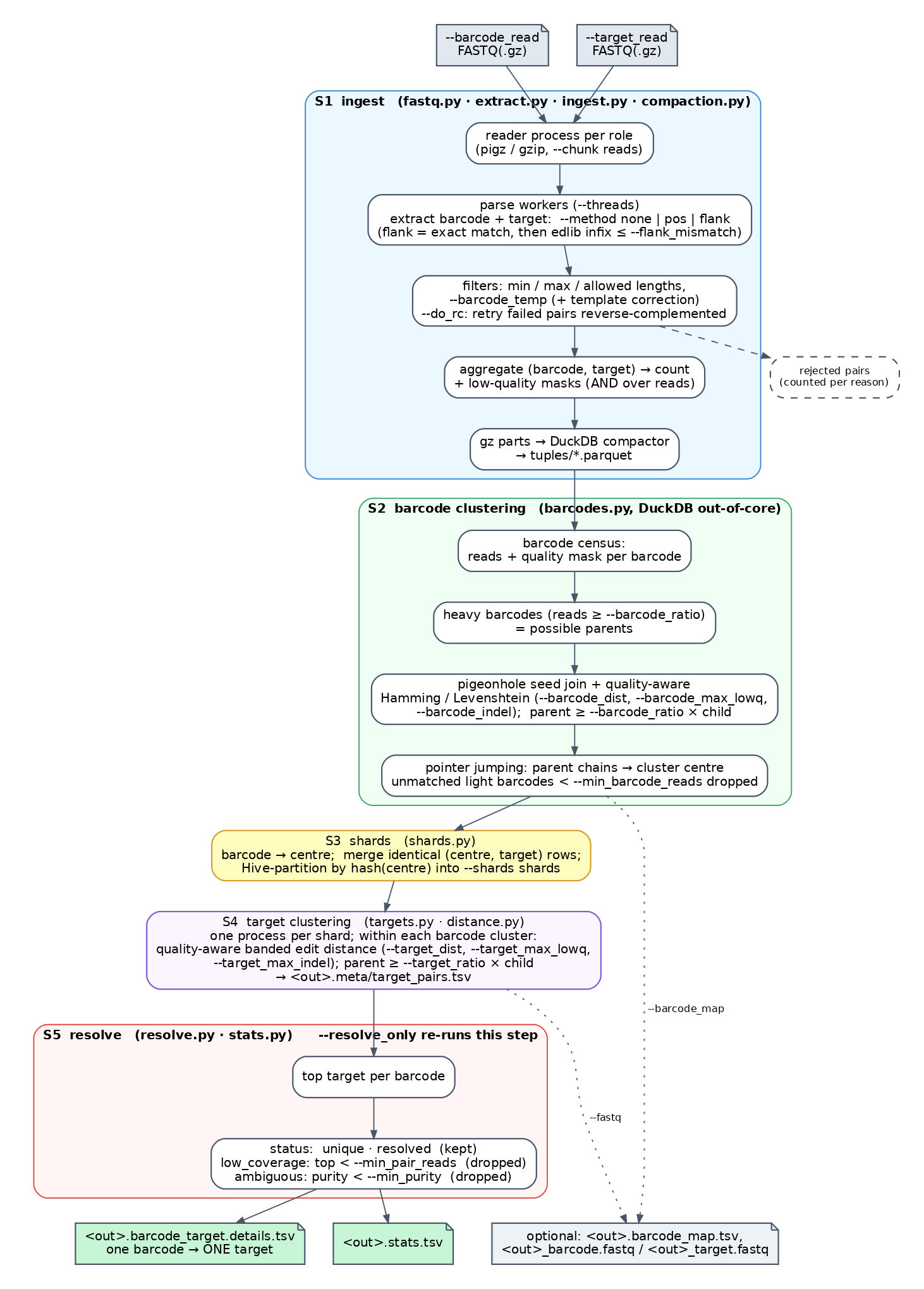
barcodex (version 0.1) links barcodes to the sequences they tag (targets: enhancers, promoters, splicing variants, ...) in very large sequencing data sets (> 10^9 read pairs). The barcode and the target are extracted from their reads (whole read, fixed position or between flanking sequences), then both barcodes and targets are clustered, using the base qualities, to remove sequencing and PCR errors. Finally ONE target is chosen per barcode. No step keeps all barcodes or reads in Python memory: the heavy work is done out-of-core by DuckDB.
The final map follows two rules: one barcode -> exactly ONE target; one target -> MANY barcodes.
Python
python = 3.11 (>= 3.11; tested with 3.11.2, DuckDB 2 needs >= 3.11)
Python Libraries
duckdb = 2.0.0   (>= 2.0) all out-of-core work: compaction (S1), barcode clustering (S2),
                          sharding (S3), reading the shards (S4), target assignment and output files (S5).
                          DuckDB 1.2.2 corrupted strings when S5 spilled to disk on a 400M-pair data set.
edlib  = 1.3.9   (>= 1.3) flank method: flanks that are not an exact match are found by an
                          edlib infix alignment (substitutions and indels)
pytest = 7       (optional) the tests use only unittest; pytest can run them too
Software (optional)
pigz = 2.6 parallel gunzip of .fastq.gz input; without it, or with --no_pigz, Python's gzip is used
Everything else is the Python standard library (argparse, multiprocessing, gzip, json, ...).
The details are in pyproject.toml.
On the Sanger farm, the HGI module has everything:
module load HGI/softpack/users/fs18/nf_starr_seqElsewhere:
git clone https://github.com/wtsi-hgi/barcodex.git
cd barcodex
pip install .                 # installs the package and a `barcodex` command
barcodex can also be run without installation, with python run_barcodex.py ... (from any
directory) or python -m barcodex ... (from the repository directory).
barcodex reads FASTQ files (plain or .gz), given in two roles:
| option | content |
|---|---|
--barcode_read |
the reads that carry the barcode |
--target_read |
the reads that carry the target |
Important
- Several files can be given per role (e.g. lanes):
--barcode_read L1_R2.fq.gz L2_R2.fq.gz --target_read L1_R1.fq.gz L2_R1.fq.gz. Both roles need the same number of files. - The two files of a role pair are read in parallel, record by record: record n of the barcode file must be the mate of record n of the target file.
- When the barcode and the target are in the same read (merged reads, PacBio HiFi reads), give the same file to both roles.
- The Phred offset is 33 by default (
--phred_offset).
#!/bin/bash
#BSUB -J barcodex
#BSUB -q normal
#BSUB -n 40
#BSUB -R "span[hosts=1] select[mem>80000] rusage[mem=80000]"
#BSUB -M 80000
#BSUB -o barcodex.%J.out
#BSUB -e barcodex.%J.err

#--------------#
# environment  #
#--------------#
module load HGI/softpack/users/fs18/nf_starr_seq

#--------------#
# barcodex     #
#--------------#
python /path/of/barcodex/run_barcodex.py \
    --barcode_read R2.fastq.gz --target_read R1.fastq.gz \
    --out results/sample1 \
    --method flank none \
    --barcode_up GTCCTCTTCCCATCT --barcode_down TGGTGGAAGCTACTGTACACCA \
    --barcode_allowed_lens 19,20,21 \
    --threads 40 --mem_gb 70
--threads and --mem_gb default to the slots of the LSF / SLURM / SGE / PBS job and 85% of
the container memory limit (32 GB if there is none). Give --mem_gb a little below the memory
requested from the scheduler.
Other ways to run it:
python -m barcodex ...                        # the same, from the repository directory
barcodex ...                                  # after pip install
python -m barcodex --version
python -m barcodex --selftest                 # synthetic data, all steps, pass / fail
Every run (and every --resolve_only) appends its command to cmd.log in the output directory.
Each entry has the date, version, host, working directory, and the command with one option per
line, so it can be copied and run again.
All options are long options (--barcode_read, --threads, ...); there are no short forms.
* stands for barcode or target.
--barcode_read                FASTQ file(s) carrying the barcodes
--target_read                 FASTQ file(s) carrying the targets (same number of files as --barcode_read)
--out                         output prefix, e.g. results/sample1 (the directory is created)
--method BARCODE TARGET       extraction method of the barcode, then of the target:
                              none (whole read), pos (by position) or flank (between flanking sequences),
                              e.g. --method flank none
Extraction (both roles):
--flank_mismatch              max edits (substitutions + indels) in a flank, method flank, default: 2
--do_rc                       retry failed pairs with BOTH reads reverse-complemented, default: off

Barcode extraction:
--barcode_start               method pos: 0-based start, default: 0
--barcode_len                 method pos: length, 0 = to the end of the read, default: 0
--barcode_up                  method flank: upstream flanking sequence
--barcode_down                method flank: downstream flanking sequence
--barcode_min_len             reject shorter barcodes, default: not set (no minimum)
--barcode_allowed_lens        keep only these lengths, e.g. 19,20,21 or 19-21, default: not set
--barcode_temp                barcode template, e.g. NNNNATNNNNATNNNNATNN, default: not set
--barcode_temp_mismatch       max mismatches at the fixed (non-N) template bases, default: 1

Target extraction:
--target_start                method pos: 0-based start, default: 0
--target_len                  method pos: length, 0 = to the end of the read, default: 0
--target_up                   method flank: upstream flanking sequence
--target_down                 method flank: downstream flanking sequence
--target_min_len              reject shorter targets, default: not set (no minimum)
--target_max_len              reject longer targets, default: not set (no maximum)
--target_allowed_lens         keep only these lengths, default: not set

Barcode clustering (S2):
--barcode_dist                max hard mismatches / edits between a barcode and its parent, default: 1
--barcode_max_lowq            max mismatches at low-quality bases, 0 = ignore quality, default: 1
--barcode_min_qual            min Phred score of a high-quality base, default: 20
--barcode_indel               max indels between a barcode and its parent (0 = Hamming), default: 0
--barcode_ratio               parent reads >= ratio x child reads; also the min reads of a parent, default: 5.0
--min_child_reads             speed-up: barcodes with fewer reads are not clustered, default: 1
--min_barcode_reads           drop unmatched barcodes with fewer reads, default: --min_pair_reads

Target clustering (S4):
--target_dist                 max hard edits between a target and its parent, default: 2
--target_max_lowq             max mismatches at low-quality bases, 0 = ignore quality, default: 5
--target_min_qual             min Phred score of a high-quality base, default: 20
--target_max_indel            max indels between a target and its parent, default: 1
--target_ratio                parent reads >= ratio x child reads, default: 5.0
--target_lowq_ratio           the same, when the differences are only at low-quality bases, default: 1.0

Target assignment (S5):
--min_pair_reads              min reads of the (barcode, top target) pair, default: 2
--min_purity                  min fraction of the barcode's purity reads on its top target, default: 0.8
--min_purity_reads            purity counts only the targets with >= X reads, default: 1 (all)

Run control:
--resolve_only                skip S1-S4, re-run S5 on the existing <out>.meta/ files
--no_resolve                  stop after S4 (writes only <out>.meta/target_pairs.tsv)
--resume                      skip the steps already finished in the work directory
--clean_meta                  delete <out>.meta/ at the end
--keep_tmp                    keep the work directory <out>.work/
--tmp                         parent directory of the work directory, default: next to --out
--db                          DuckDB file of S5 to keep, default: in memory, spills to <out>.duckdb.tmp
--max_reads                   pilot run: use only the first X read pairs, 0 = all, default: 0

Resources and tuning:
--threads                     worker processes / DuckDB threads, default: job slots
--mem_gb                      RAM budget in GB, default: 85% of the memory limit, else 32
--shards                      number of S3 / S4 shards, default: 64
--chunk                       reads per parse chunk, default: 100000
--agg_entries                 max (barcode, target) entries per worker before a part is written,
                              0 = derive from --mem_gb, default: 0
--compact_parts               compact text parts into Parquet when X are pending, default: 12
--merge_files                 merge X same-level Parquet files into the next level, default: 6
--max_cand                    seeds shared by more than X heavy barcodes are ignored, default: 5000
--max_dp_group                barcodes with more target variants than X use Hamming only (no indels), default: 1000
--max_parents                 within one barcode, compare each target only with the X most abundant, default: 200
--no_pigz                     read .gz with Python's gzip instead of pigz

Other:
--phred_offset                Phred offset of the qualities, default: 33
--barcode_map                 also write <out>.barcode_map.tsv (raw barcode -> cluster centre)
--fastq                       also write <out>_barcode.fastq / <out>_target.fastq
--selftest                    run all steps on synthetic data and exit
--version                     print the version and exit
An option of another method is an error, for example --method none none --barcode_len 16.
Promoter library (STARR-seq), with the same settings as run_asso_promoter.sh:
python run_barcodex.py --barcode_read Adept_SS_L1_R2.fastq.gz --target_read Adept_SS_L1_R1.fastq.gz \
    --out GP_input --method flank none \
    --barcode_up GTCCTCTTCCCATCT --barcode_down TGGTGGAAGCTACTGTACACCA --barcode_allowed_lens 19,20,21 \
    --threads 40 --mem_gb 80
Splicing library combi_6 (merged reads, so both roles read the same file), with the same
settings as associate_variant_barcode.py in run_bc.sh:
python run_barcodex.py --barcode_read combi_6.extendedFrags.fastq.gz \
    --target_read combi_6.extendedFrags.fastq.gz --out combi_6 \
    --method flank flank --flank_mismatch 2 \
    --target_up tccaatgttccaacctacag --target_down tctttgttctttcagTGAAG --target_min_len 170 \
    --barcode_up GCAGAAAGCACAGAAAGGAA --barcode_down CTACTGATTCGATGCAAGCTT \
    --barcode_temp NNNNATNNNNATNNNNATNNNNATNNNNATNNNNATNN --barcode_temp_mismatch 1 \
    --min_pair_reads 3 --threads 40 --mem_gb 70
associate_variant_barcode.py |
barcodex |
|---|---|
--read1 (variant) / --read2 (barcode) |
--target_read / --barcode_read |
| flanks for both | --method flank flank |
--variant_up / --variant_down |
--target_up / --target_down |
--variant_check --variant_len 170 |
--target_min_len 170 |
--barcode_check --barcode_temp T |
--barcode_temp T |
--barcode_mismatch 1 |
--barcode_temp_mismatch 1 |
--max_mismatches 2 |
--flank_mismatch 2 |
--min_barcov 3 |
--min_pair_reads 3 (applied after the clustering) |
PacBio HiFi reads (barcode and long target in the same read, either strand):
python run_barcodex.py --barcode_read hifi.fastq.gz --target_read hifi.fastq.gz --out hifi \
    --method flank flank --do_rc \
    --barcode_up <UP> --barcode_down <DOWN> --barcode_allowed_lens 20 \
--target_up <UP> --target_down <DOWN> --target_min_len 500📁 <output dir>
├───📄 cmd.log # commands of all runs
├───📄 <prefix>.barcode_target.details.tsv # final map: one row per (barcode, target)
├───📄 <prefix>.stats.tsv # read and sequence counts of every step
├───📄 <prefix>.barcode_map.tsv # optional, --barcode_map
├───📄 <prefix>_barcode.fastq # optional, --fastq
├───📄 <prefix>_target.fastq # optional, --fastq
├───📁 <prefix>.meta # intermediate files for --resolve_only (--clean_meta deletes it)
│ ├───📄 ingest_stats.json # S1 read counts and reject reasons
│ ├───📄 raw_stats.json # S2 raw barcode / target counts
│ ├───📄 barcode_clusters.parquet # S2 statistics of every barcode cluster
│ └───📄 target_pairs.tsv # S4 (barcode cluster, target cluster) rows
└───📁 <prefix>.work # work directory while running (--tmp, --keep_tmp)📄 <prefix>.barcode_target.details.tsv
Note
One row per final (barcode, target) pair. Every final barcode has exactly one target, so each
row describes one barcode, one target and that pair. The rows are sorted by barcode_reads
(most first).
| column | meaning |
|---|---|
barcode, target |
barcode (centre of its cluster) and its target (centre of its cluster under this barcode) |
barcode_reads |
reads of the barcode cluster: the sum of the reads of all raw barcodes clustered into this barcode |
n_diff_barcodes |
number of different raw barcodes clustered into this barcode |
first_barcode_cov, first_barcode_ratio |
reads of the most abundant raw barcode, and first_barcode_cov / barcode_reads |
second_barcode_cov, second_barcode_ratio |
the same for the second most abundant raw barcode (0 if none) |
target_reads |
reads of this target under this barcode: the sum of the reads of all raw target sequences clustered into it |
n_diff_targets |
number of different raw target sequences clustered into this target under this barcode |
first_target_cov, first_target_ratio |
reads of the most abundant target sequence, and first_target_cov / target_reads |
second_target_cov, second_target_ratio |
the same for the second most abundant target sequence (0 if none) |
Example: barcode 1 is a cluster of 4 raw barcodes barA, barB, barC, barD with readA >= readB >=
readC >= readD reads. Then barcode_reads = readA + readB + readC + readD, first_barcode_ratio =
readA / barcode_reads and second_barcode_ratio = readB / barcode_reads. A second ratio far
below the first means barA is the real barcode and the others are sequencing errors or noise.
The target columns work the same way for the target sequences clustered into the target under
this barcode. target_reads can be smaller than barcode_reads: reads of the barcode that
support other (minor) targets are not counted.
Example (combi_6; the 180 bp targets are shortened here with ...):
barcode	target	barcode_reads	n_diff_barcodes	first_barcode_cov	first_barcode_ratio	second_barcode_cov	second_barcode_ratio	target_reads	n_diff_targets	first_target_cov	first_target_ratio	second_target_cov	second_target_ratio
ATACATTGTTATTGTGATTAACATTAGGATAGATATTT	GATACACTATGG...GGCACGGGTGAGG	7515	36	7436	0.9895	19	0.0025	7392	720	6283	0.85	55	0.0074
ATAGATTGTTATTTATATGAAAATTGCGATCGGCATAA	GAATGTCACGGT...GCTCACGGATTTTACT	4319	24	4285	0.9921	6	0.0014	4206	442	3511	0.8348	33	0.0078
CTTGATTCACATTTTTATGTGAATCTGCATATGGATAT	GAGTAGTCTTCG...GCCGAGGCATAGGGCGTGGG	3793	10	3781	0.9968	2	0.0005	3779	257	3310	0.8759	34	0.009
📄 <prefix>.stats.tsv
Note
Columns step, stat, count, percent and description; the rows are ordered by step.
Stat names start with reads_ (read-pair counts), num_ (numbers of sequences / barcodes /
targets) or mean_ / median_. percent is filled for reads_* rows
(count / reads_raw_input x 100) and is NA otherwise.
step	stat	count	percent	description
1_input	reads_raw_input	93586470	100.00	read pairs in the FASTQ files
2_extraction	reads_target_upstream_not_found	7871550	8.41	read pairs rejected: upstream flank (--target_up) not found
2_extraction	reads_barcode_incorrect_template	3820737	4.08	read pairs rejected: barcode does not match --barcode_temp NNNNATNNNNATNNNNATNNNNATNNNNATNNNNATNN
2_extraction	num_raw_barcodes	3810485	NA	distinct barcode sequences extracted (before barcode clustering)
3_barcode_clustering	num_barcodes_after_clustering	2581082	NA	barcodes (barcode clusters) after clustering
5_target_assignment	num_barcodes_ambiguous	36442	NA	multi-target barcodes NOT resolved: their top target has >= 3 reads (--min_pair_reads) but < 0.8 of the barcode's reads (--min_purity), no dominant target; dropped
6_final_map	reads_final_effective	69897106	74.69	reads supporting the final (barcode, target) pairs
6_final_map	median_barcode_coverage	23	NA	median reads per final barcode (after clustering)
| step | stats |
|---|---|
1_input |
reads_raw_input |
2_extraction |
one reads_<target|barcode>_<reason> row per reject reason (target rows first), reads_reverse_complemented (with --do_rc), then num_raw_barcodes, num_raw_targets, num_raw_barcode_target_pairs |
3_barcode_clustering |
reads_dropped_barcode_clustering, reads_in_barcode_clustering, num_barcodes_after_clustering |
4_target_clustering |
reads_dropped_target_clustering, reads_in_target_clustering, num_target_after_clustering |
5_target_assignment |
reads_ / num_barcodes_multi_targets, reads_ / num_barcodes_resolved, reads_ / num_barcodes_ambiguous, reads_ / num_barcodes_low_coverage |
6_final_map |
num_final_barcodes, num_final_targets, num_final_barcode_target_pairs, reads_final_effective, mean_ / median_barcode_coverage, mean_ / median_target_coverage, mean_barcodes_per_target |
Important
The read counts add up:
reads_raw_input= the reject rows of2_extraction+reads_dropped_barcode_clustering+reads_in_barcode_clusteringreads_in_barcode_clustering=reads_dropped_target_clustering+reads_in_target_clusteringreads_in_target_clustering=reads_barcodes_low_coverage+reads_barcodes_ambiguous+reads_final_effective+ the reads of resolved barcodes that support a minor target
Reject rows appear only for the reasons that the chosen settings can produce:
*_upstream_not_found, *_downstream_not_found, *_missing (empty sequence),
barcode_read_too_short (pos method), target_too_long (--target_max_len),
*_incorrect_length (--*_min_len), *_length_not_allowed (--*_allowed_lens) and
*_incorrect_template (--barcode_temp). Each rejected pair is counted once, under the first
reason that applies. The checks run in the same order as in the associate_*.py scripts: target
extraction, barcode extraction, target filters, barcode filters.
📄 <prefix>.barcode_map.tsv (--barcode_map)
Note
One row per raw barcode kept by the barcode clustering (dropped barcodes are not listed).
| barcode | reads | centre_barcode |
|---|---|---|
| raw barcode | its reads | the cluster centre it was merged into |
📄 <prefix>_barcode.fastq, <prefix>_target.fastq (--fastq): a representative FASTQ pair
of the clustered barcodes and targets.
| step | module | what it does |
|---|---|---|
| S1 ingest | fastq.py, extract.py, ingest.py, compaction.py |
One reader process per FASTQ role passes chunks to the parse workers. The workers extract the barcode and the target, count rejects, and aggregate (barcode, target) -> count + low-quality masks in a bounded dict. The dict is written to gz parts, which a background DuckDB compactor merges into Parquet. |
| S2 barcodes | barcodes.py |
DuckDB barcode census. Barcodes with at least --barcode_ratio reads ("heavy" barcodes) can be parents. Each barcode is matched to a parent with a pigeonhole seed join and a quality-aware Hamming or Levenshtein distance. Chains of parents are followed to the root by pointer jumping. |
| S3 shards | shards.py |
Replaces each barcode by its cluster centre, merges identical (centre, target) rows and writes Hive-partitioned shards by hash(centre), so all rows of one barcode cluster are in one shard. |
| S4 targets | distance.py, targets.py |
Clusters the targets of each barcode, quality-aware, with one process per shard. |
| S5 resolve | resolve.py, stats.py |
Chooses one target per barcode and writes the result files and the stats. Its tables hold no sequences: barcodes and targets are keyed by md5_number(), and the sequences are read again from target_pairs.tsv only while the result files are written. |
Other modules:
cli.py: options, validation,cmd.log,mainsteps.py: order of the steps and--resumecommon.py: logging, SQL quoting, resources, meta pathsconstants.pyselftest.py
--method takes two values: first the barcode method, then the target method. They are
independent: for example, --method pos flank takes the barcode by position and the target
between flanks, and --method flank none uses the whole target read.
| method | the sequence is | options (* = barcode or target) |
|---|---|---|
none |
the whole read | none |
pos |
a fixed window | --*_start (0-based), --*_len (0 = to the end of the read) |
flank |
between two flanking sequences | --*_up, --*_down, and --flank_mismatch (default 2, shared by barcode and target) |
- pos: a barcode read that is too short is rejected (
barcode_read_too_short). A short target is kept as it is. - flank: the flanks are found on the sequence only, without base qualities. The upstream
flank is searched first. The barcode / target starts where the upstream flank match ends and
ends where the downstream flank match starts (searched after the upstream flank). Each flank
is found in two steps (
find_flank):- an exact match (
bytes.find, C speed; most reads); - otherwise the best edlib infix alignment with at most
--flank_mismatchedits (substitutions and indels,match_edlib). The match boundaries are the alignment boundaries, so an indel inside a flank does not shift the barcode / target. When several alignments have the same number of edits, one of the flank length (substitutions) is preferred, then the leftmost.
- an exact match (
Comparison with the Hamming window search of nf_starr_seq
This replaced the Hamming window search (match_hamming_numpy) and the fixed-length
Levenshtein window search (match_levenshtein) of nf_starr_seq/scripts/sequence_utils.py,
and the option --flank_distance that chose between them. An indel near the inner end of a
flank (next to the barcode / target) shifts only the last flank bases, so the Hamming window is
accepted with 1-2 mismatches and the sequence comes out shifted by one base; the old Levenshtein
window search shifted the sequence even for exact flanks (with --flank_mismatch 2 the window
one base before an exact flank already matches). Simulated reads with the hek16 barcode flanks
(21 / 20 bp, 38 bp barcode, --flank_mismatch 2), 5,000 reads per row, % correct / wrong
barcode / lost:
| upstream flank | old Hamming | barcodex |
|---|---|---|
| exact | 100 / 0 / 0 | 100 / 0 / 0 |
| 1 substitution | 100 / 0 / 0 | 100 / 0 / 0 |
| 2 substitutions | 100 / 0 / 0 | 99.9 / 0.1 / 0 |
| 1 indel | 14.4 / 6.4 / 79.2 | 98.1 / 1.9 / 0 |
| 1 indel 2-3 bases from the barcode | 0 / 62.8 / 37.2 | 80.8 / 19.2 / 0 |
The remaining "wrong" cases are ties: another explanation with the same number of edits (e.g. an insertion next to the barcode = a substitution + a 1-base shift); no method can tell them apart. Speed (95% exact, 4% 1 substitution, 1% 1 indel): 1.5 µs per read, the Hamming window search 83 µs.
For any method:
--*_min_len Nrejects shorter sequences, for example--target_min_len 170. Not set (the default) = no minimum.--target_max_len Nrejects longer targets (target_too_long). Not set (the default) = no maximum: targets of any length are kept, for example 500-1000 bp inserts in PacBio reads.--*_allowed_lens 19,20,21(or19-21) keeps only these lengths.--barcode_temp NNNNATNN...applies to barcodes only. The barcode must have the template length, and its fixed (non-N) bases may differ in at most--barcode_temp_mismatchpositions (default 1). This is the same rule ascheck_barcodein the splicing pipeline. A barcode that passes with mismatching fixed bases is then corrected: those bases are set to the template base (templateNNNNATNNNNATNNNNATNN, barcodeCCCCCTGGGGATCCCCATGG->CCCCATGGGGATCCCCATGG), so it is counted with the error-free barcode already in S1. Most barcodes match the template exactly and are passed through after one regex match; only the others are rebuilt (0.4 µs per barcode, 7x faster than a per-base loop over the whole barcode, same result).
Important
With the flank method, use one of these filters for barcodes. Very short barcodes stop S2 with "barcodes too short" (the pigeonhole seeds need at least 4 bases each).
- Without
--do_rcthe barcode and the target are searched on the forward strand only. - With
--do_rc, a read pair that fails on the forward strand (any extraction or filter reject) is tried again with BOTH reads reverse-complemented (sequences and qualities). A pair that passes on the forward strand is never reverse-complemented. The barcode and the target always come from the same strand: a forward barcode is never combined with a reverse-complemented target, or the other way round. - If both orientations fail, the pair is counted under the reject reason of the orientation that got further in the check order.
- The stats file reports the pairs found on the reverse complement as
reads_reverse_complemented(kept pairs, not a reject row). - Use it for reads that come from either strand, for example PacBio HiFi reads, where the barcode
and the target are in the same read (
--barcode_readand--target_readare the same file).
Barcodes (S2) and the targets of each barcode (S4) are clustered the same way: sequences are
sorted by reads, and a sequence is merged into a more abundant parent when they are close enough
and the parent has at least --*_ratio times its reads. Chains of parents end at their root,
the cluster centre.
- A mismatch is hard when both bases are confident (Phred >=
--*_min_qual, ACGT); it counts towards--barcode_dist/--target_dist. - It is low when one of the two bases has low quality or is N; it counts towards
--*_max_lowq. For targets that differ only at low-quality bases,--target_lowq_ratioreplaces--target_ratio. - A base is low quality only if it was low quality in every read that carried that sequence.
- Set
--barcode_max_lowq 0or--target_max_lowq 0to turn quality off. Barcodes longer than 32 bp are clustered without quality (their quality mask is packed in one 64-bit word). - Barcodes: Hamming distance, or Levenshtein with
--barcode_indel > 0. Unmatched barcodes with fewer than--min_barcode_readsreads are dropped. - Targets: banded edit distance with up to
--target_max_indelindels. Barcodes with more than--max_dp_grouptarget variants use Hamming only, and each target is compared with at most the--max_parentsmost abundant targets of its barcode.
S5 takes the target with the most reads of each barcode cluster (the top target) and gives the barcode a status:
| status | rule | kept |
|---|---|---|
| unique | a single target, with >= --min_pair_reads reads |
yes |
| resolved | several targets; the top target has >= --min_pair_reads reads and a purity >= --min_purity |
yes, with the top target |
| ambiguous | several targets; the top target has enough reads but a purity < --min_purity (no dominant target) |
no |
| low_coverage | the top target has < --min_pair_reads reads |
no |
- purity = top target reads / purity reads. Purity reads = the barcode's reads minus the reads of
its other targets with <
--min_purity_readsreads (after target clustering; the top target always counts). --min_purity_reads 1(default): all of the barcode's reads.--min_purity_reads 2: 1-read targets, mostly noise, do not lower the purity.num_final_barcodes= unique + resolved barcodes.
--resume: S1-S3 write a marker file in<prefix>.work/(ingest.done,bcmap.done,shards.done); with--resume, finished steps are skipped. Use it with--keep_tmpor after a crash (the work directory is deleted only at the end of S4).--resolve_only: re-runs only S5 on<prefix>.meta/, e.g. to try other--min_pair_reads,--min_purityor--min_purity_readsvalues in minutes instead of hours.--no_resolve: stops after S4.--max_reads N: a quick pilot run on the first N read pairs, to check the extraction settings and the reject reasons in the stats file before the full run.
python -m barcodex --selftest                 # synthetic data, all steps, pass / fail
python -m unittest discover -s tests          # unit tests, one file per step
The tests write to the system temp directory; set TMPDIR to put them elsewhere.
| test file | what it covers |
|---|---|
test_extract.py |
none / pos / flank extraction (exact-then-edlib flanks, indels, ties), length and template filters, template correction, reject order |
test_cli.py |
options, --method, validation, cmd.log, --version |
test_s1_ingest.py |
FASTQ reader, read parsing and reject order, part files, compaction, step S1 |
test_s2_s3_barcodes_shards.py |
barcode clustering (S2) and sharding (S3) |
test_s4_targets.py |
edit distance, target clustering within a barcode, step S4 |
test_s5_resolve.py |
one target per barcode, output columns, stats file by step, --min_purity_reads |
test_long_targets_rc.py |
targets longer than 256 bp (--target_max_len), --do_rc |
test_all_steps.py |
all steps on synthetic data (pos none and flank pos scenarios) |
- Every function has a docstring with a description, Parameters and Returns.
- Steps inside a function are marked
# stepN : text, and their parts# |---- substep text. - Options are long snake_case options with the same name as the variable:
--max_reads->args.max_reads. - The workflow figure is drawn with Graphviz from
image/barcodex_workflow.dot:dot -Tpng -Gdpi=130 image/barcodex_workflow.dot -o image/barcodex_workflow.png.